Net force is a fundamental concept in physics that is pivotal for understanding motion and the resultant behavior of objects in various scenarios. In essence, net force is the total force acting on an object when multiple forces are involved. This concept can be easily misunderstood without a firm grasp of its significance and calculations.
This article delves into the practical application of net force through evidence-based examples and expert insights, elucidating how it influences the dynamics of motion.
Key Insights
- Net force is the vector sum of all forces acting on an object; it determines the object's acceleration.
- A practical application of net force involves the analysis of multi-force systems, essential for engineering and dynamic systems.
- Understanding net force is crucial for designing safety protocols in various industries such as automotive, aviation, and construction.
Understanding Net Force: Concept and Calculation
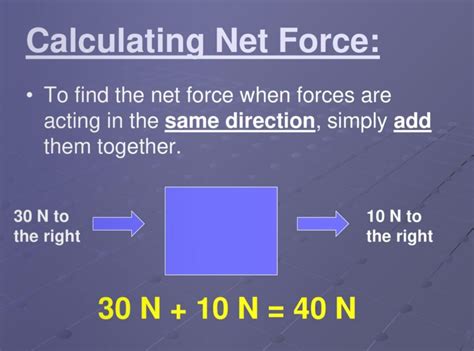
Net force is a vector quantity, meaning it has both magnitude and direction. It is crucial to calculate net force to understand an object’s resulting motion. When forces act in opposite directions, their magnitudes are subtracted vectorially. Conversely, if they act in the same direction, they are added. Newton’s Second Law, which states that the acceleration of an object is directly proportional to the net force acting upon it and inversely proportional to its mass, further underscores its importance. For instance, in automotive engineering, calculating the net force helps in designing braking systems that maximize stopping power while ensuring safety.
Applications of Net Force in Real-World Scenarios
Real-world applications of net force are prevalent in various industries. In aviation, for example, pilots must constantly account for multiple forces like lift, thrust, drag, and weight to maintain stable flight and ensure passenger safety. Here, understanding net force is crucial for accurate flight dynamics. Engineers in the construction industry utilize net force calculations to design buildings that can withstand various environmental forces such as wind and seismic activity. In everyday life, understanding net force can help us in scenarios like pushing a cart; if two friends push a cart in the same direction, the net force is the sum of their individual pushes, making it easier to move the cart. Conversely, if one pushes forward and another pushes backward, the net force would be the difference between these forces.
What happens if there is no net force acting on an object?
When no net force is acting on an object, it remains in a state of equilibrium. If it was at rest, it stays at rest; if it was moving, it continues to move with a constant velocity, according to Newton’s First Law of Motion.
Can net force ever be zero even when multiple forces are acting on an object?
Yes, if all the forces acting on an object are balanced, meaning they cancel each other out, the net force will be zero. This results in no acceleration, and the object will either remain stationary or move at a constant velocity.
Understanding net force is paramount in fields ranging from mechanical engineering to basic physics experiments. By mastering this concept, professionals and enthusiasts alike can more accurately predict and manipulate the motion of objects, contributing to safer and more efficient designs and solutions across various domains.