Pseudostratified ciliated columnar epithelium (PCCE) is an essential component of the respiratory tract, serving as a crucial barrier and functional tissue in the mucociliary clearance system. Understanding its structure and function can significantly enhance medical diagnoses and therapeutic strategies for respiratory diseases.
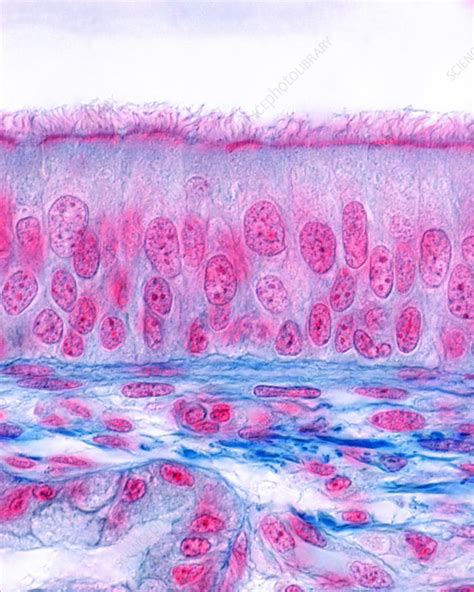
Pseudostratified ciliated columnar epithelium presents as a single layer of cells that appear stratified due to their varying heights and overlapping nuclei. This epithelium lines significant parts of the respiratory tract, including the trachea and bronchi, and it plays an indispensable role in maintaining respiratory health through its ciliated structure.
Key insights box:
Key Insights
- The pseudostratified ciliated columnar epithelium acts as a dynamic barrier in the respiratory tract.
- Its cilia are involved in the clearance of inhaled particles and pathogens through coordinated beating.
- Practical applications involve enhancing mucociliary clearance as a therapeutic approach for chronic respiratory diseases.
The complex structure of pseudostratified ciliated columnar epithelium is a marvel of biological engineering. Despite the apparent stratification, all cells in this epithelium rest on a single basal lamina, allowing the cells to project into the lumen where they perform their critical functions. The nuclei of these cells vary in position, contributing to the “false stratified” appearance.
The functionality of this epithelium is predominantly governed by its cilia. These hair-like projections cover the surface of the cells and beat in coordinated waves, driving the mucus layer along the respiratory tract. This mucociliary escalator is vital in trapping and expelling foreign particles, pathogens, and particulate matter from the airways, thereby protecting the lower respiratory system from infection and irritation.
Mechanisms of Action in Respiratory Health
The mucociliary clearance system facilitated by pseudostratified ciliated columnar epithelium is crucial in maintaining respiratory health. In the trachea and bronchi, cilia beat in a coordinated rhythm to move mucus, along with trapped bacteria, dust, and other particles, towards the pharynx where it can be swallowed or expelled through coughing. This mechanism is not only fundamental for clearing the respiratory tract but also plays a pivotal role in preventing chronic respiratory diseases such as chronic bronchitis and cystic fibrosis.Research has demonstrated that the function of cilia can be compromised by various factors, including infections, inflammatory processes, and genetic mutations. In particular, conditions like cystic fibrosis are characterized by defective cilia due to mutations in the CFTR gene, resulting in impaired mucus clearance and increased susceptibility to infections.
Clinical Implications and Therapeutic Interventions
Given the integral role of pseudostratified ciliated columnar epithelium in respiratory health, understanding its mechanics opens avenues for therapeutic interventions. One practical recommendation is to focus on enhancing the function of the mucociliary clearance system in patients with compromised ciliary function. Pharmacological agents that increase mucus production, or devices that assist in mucociliary clearance, can be particularly beneficial.Another area of interest is the development of gene therapies aimed at correcting genetic defects that affect ciliary function, as seen in conditions like primary ciliary dyskinesia (PCD). Advances in gene therapy have shown promise in preclinical models, suggesting potential future treatments for genetic disorders affecting this epithelium.
How does pseudostratified ciliated columnar epithelium protect the respiratory tract?
The pseudostratified ciliated columnar epithelium protects the respiratory tract by utilizing coordinated ciliary beating to move mucus and trapped particles out of the airways, thereby preventing infections and irritation.
What happens when the function of this epithelium is compromised?
When the function of pseudostratified ciliated columnar epithelium is compromised, it can lead to chronic respiratory diseases such as chronic bronchitis and cystic fibrosis due to impaired mucociliary clearance and increased susceptibility to infections.
In conclusion, the pseudostratified ciliated columnar epithelium is a dynamic and critical component of the respiratory system, essential for maintaining airway health through its mucociliary clearance mechanism. By understanding its structure and function, medical professionals can devise better strategies for diagnosing and treating respiratory diseases.