Master the Area of Parallelogram Formula: Quick and Easy Guide
Welcome to your comprehensive guide on understanding and mastering the area of a parallelogram formula. Whether you’re a student tackling your first geometry project or a professional seeking a quick refresher, this guide will walk you through every step of the process. By the end of this guide, you’ll not only know how to calculate the area of a parallelogram but also understand the underlying concepts and methods to solve various problems efficiently.
Understanding the area of a parallelogram is fundamental in geometry, and knowing the formula is crucial for solving many real-world problems. This guide will provide you with clear, actionable advice, practical examples, and essential tips to help you master this concept. Let’s dive in!
Why Is Understanding the Area of a Parallelogram Important?
The area of a parallelogram is not just an abstract mathematical concept; it has practical applications in fields ranging from architecture to design. Knowing how to calculate it can help you in tasks such as determining the amount of materials needed for construction, understanding land area for real estate, or even designing graphics. The formula is straightforward, but getting comfortable with it and applying it in different scenarios is where the real mastery lies.
Quick Reference
Quick Reference
- Immediate action item: Measure the base and height of your parallelogram.
- Essential tip: The formula to find the area is Area = base × height.
- Common mistake to avoid: Confusing the base and height dimensions.
Step-by-Step Guide to Calculating the Area of a Parallelogram
Calculating the area of a parallelogram involves understanding a few basic concepts and applying a simple formula. Let’s break it down step-by-step:
Step 1: Identify the Base and Height
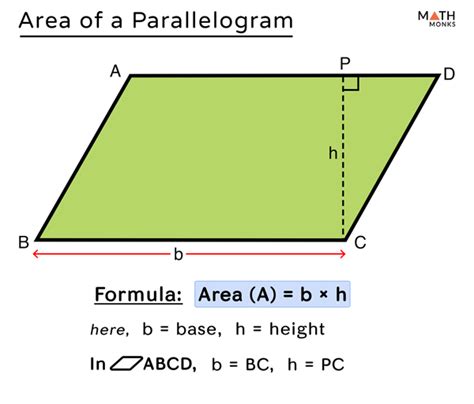
The first step is to clearly identify the base and the height of the parallelogram. The base is any one of the parallel sides, and the height is the perpendicular distance from the base to the opposite side.
For example, consider a parallelogram where one side measures 10 units (this is your base), and the perpendicular distance from this side to the opposite side is 5 units (this is your height).
Step 2: Apply the Area Formula
Once you have identified the base and height, you can apply the area formula:
Area = base × height
Using our example from above, you would calculate:
Area = 10 units × 5 units = 50 square units
Step 3: Verify Your Calculation
Double-check your measurements and ensure that the base and height are accurately perpendicular to each other to confirm the validity of your calculation.
Tips and Best Practices
To ensure you’re getting the most out of your parallelogram area calculations, here are some best practices:
- Always measure the perpendicular distance to avoid errors in calculation.
- Use a ruler for accurate measurements and avoid estimating if possible.
- Double-check your units—ensuring that both base and height are measured in the same units is crucial.
Practical Examples
Here are some practical examples to further clarify the concept:
Example 1: Area of a Parallelogram in a Real-World Setting
Imagine you’re tasked with finding out how much paint you need to cover the wall section that is shaped like a parallelogram. The base of this section is 8 meters, and the height is 4 meters. Using the formula:
Area = 8 meters × 4 meters = 32 square meters
Therefore, you need 32 square meters of paint to cover this section of the wall.
Example 2: Designing a Garden Path
Suppose you’re designing a garden path with a parallelogram shape. One side of the path is 12 feet, and the height is 3 feet. Calculating the area:
Area = 12 feet × 3 feet = 36 square feet
This means you will need 36 square feet of material to cover the garden path.
Practical FAQ
What if the height is not perpendicular?
If the height is not perpendicular to the base, it’s not a true height for the area calculation. You’ll need to measure the perpendicular distance from the base to the opposite side. Sometimes, this might involve using trigonometric functions if the angles are known.
Can the formula work for any parallelogram?
Yes, the formula works for any parallelogram. The base and height must be measured accurately, especially the height, which should be perpendicular to the base for the calculation to be correct.
How does skewing affect the calculation?
If a parallelogram is skewed, and you cannot measure the perpendicular height directly, you might need to use a combination of geometry and trigonometry to determine the effective height. However, this is beyond the basic formula and requires a deeper understanding of geometric principles.
By following this guide, you’ll have a strong foundation in calculating the area of a parallelogram. Practice with different shapes and measurements to ensure you’re comfortable with the formula and can apply it in various scenarios. Whether it’s for academic purposes, professional tasks, or everyday use, this knowledge will be invaluable.