When delving into the realm of calculus, one frequently encounters limits. Understanding when a limit does not exist is crucial for analyzing functions and their behavior as inputs approach certain values. To grasp this concept firmly, it’s imperative to recognize not just the definitions but the practical applications and nuances that come into play.
Key insights box:
Key Insights
- Primary insight with practical relevance: Limit does not exist when function values don’t approach a single number.
- Technical consideration with clear application: Asymptotes often indicate non-existent limits.
- Actionable recommendation: Visualize the function’s graph to identify where limits fail to exist.
When discussing the existence of limits, the central question often revolves around whether the function values approach a specific number as the input gets closer to a certain value. If the function values diverge or approach different numbers from different directions, we determine that the limit does not exist.
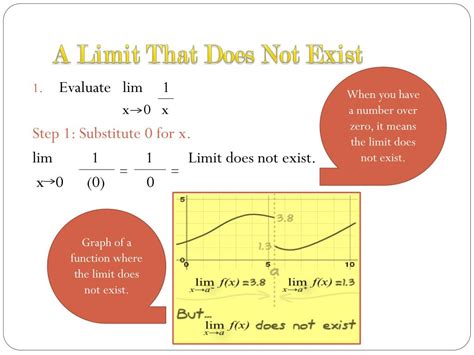
For instance, consider the function f(x) = 1/x as x approaches 0. As x gets closer and closer to 0 from the positive side (right-hand limit), f(x) tends to positive infinity. Conversely, as x approaches 0 from the negative side (left-hand limit), f(x) tends to negative infinity. Because the function values diverge to positive and negative infinity, we conclude that the limit of f(x) as x approaches 0 does not exist.
To better understand non-existent limits, another common scenario involves vertical asymptotes. For example, in the function g(x) = 1/(x - 2), as x approaches 2, the function values soar toward positive or negative infinity. This drastic change signifies the vertical asymptote at x = 2 and affirms that the limit does not exist here. The concept of asymptotes underscores an essential point in calculus: as we zoom in on the behavior of the function near such points, we often find that it shoots off to infinity, confirming the non-existence of a limit.
In another context, consider piecewise-defined functions. Let’s say we have a function h(x) that is defined as h(x) = -1 if x < 0 and h(x) = 1 if x ≥ 0. As x approaches 0 from the left, the function approaches -1, but as x approaches 0 from the right, it approaches 1. Here, the left-hand limit and right-hand limit are different, leading to the conclusion that the limit as x approaches 0 does not exist.
A thorough understanding of these principles is critical, especially in fields like engineering, physics, and economics, where precise mathematical modeling often depends on correctly identifying where limits do not exist. By recognizing that limits require the function values to converge to a single number, we can confidently assert the non-existence of limits in diverse and practical scenarios.
FAQ section
Can a limit not exist at infinity?
Yes, a limit can fail to exist as x approaches infinity if the function does not settle towards a finite number or if it diverges to positive or negative infinity.
Is it possible for a limit to exist at points where the function is undefined?
No, a limit cannot exist at points where the function itself is undefined. However, it might exist at these points if the function can be redefined (such as in removable discontinuities).
The clarity of understanding when a limit does not exist forms the backbone of proficient calculus skills. With practical insights and visual aids, we can adeptly navigate the complex behavior of functions, thereby enhancing our analytical precision across various domains.