Understanding Kinetic vs. Potential Energy: Key Differences Explained
Navigating the world of physics often introduces us to concepts like kinetic and potential energy. These are foundational ideas in understanding how objects move and interact. While they both describe forms of energy, their differences are crucial for anyone looking to delve deeper into physics or apply these principles in real-world scenarios. This guide will walk you through the fundamental differences, practical examples, and the ways in which you can leverage this knowledge.
Problem-Solution Opening Addressing User Needs
Imagine you’re a student trying to ace your physics exams, or maybe you’re someone trying to understand how machines work in your engineering projects. Both kinetic and potential energy are central to understanding the movement and stored energy in various systems. Often, the challenge lies in comprehending the distinctions and knowing how to apply this knowledge effectively. This guide aims to demystify these concepts, providing you with a clear, step-by-step approach to understand and utilize kinetic and potential energy in practical scenarios.
By the end of this guide, you will be able to confidently tackle physics problems involving energy, apply these principles to real-world examples, and even start thinking critically about energy in daily activities.
Quick Reference
Quick Reference
- Immediate Action Item: Identify a moving object around you; note how its speed affects the energy it holds. This is kinetic energy at work.
- Essential Tip: Understand that potential energy is stored energy, like that in a stretched spring or an elevated object, ready to be converted into kinetic energy.
- Common Mistake to Avoid: Confusing potential energy with kinetic energy. Remember, potential energy is stored until it’s released or used.
What is Kinetic Energy?
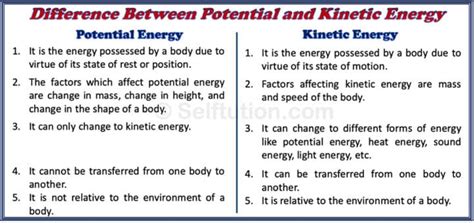
Kinetic energy is the energy of motion. When an object is in motion, such as a car driving down the road, a ball in play, or even air molecules moving to create wind, it possesses kinetic energy. This energy is directly related to the mass of the object and its velocity, as shown in the formula:
Kinetic Energy = ½ * mass * velocity^2
This formula highlights that the more massive the object and the faster it moves, the more kinetic energy it has.
To make this concept clearer, consider a baseball pitcher throwing a ball. When the ball leaves the pitcher's hand, it has significant kinetic energy because of its speed. On the other hand, a stationary baseball has no kinetic energy because its velocity is zero.
Here’s a practical example: Think about a race car on a racetrack. When the car accelerates from rest to its top speed, its kinetic energy increases dramatically. Engineers can calculate this kinetic energy to design more efficient engines and track systems, ensuring the cars are both fast and safe.
What is Potential Energy?
Potential energy, in contrast, is the stored energy an object possesses due to its position or configuration. This type of energy has the potential to be converted into kinetic energy under the right conditions. Common forms of potential energy include gravitational potential energy, elastic potential energy, and chemical potential energy.
For gravitational potential energy, the formula is:
Gravitational Potential Energy = mass * gravity * height
This means the higher an object is above the ground, the more gravitational potential energy it holds.
Consider an example: Imagine a roller coaster at the top of its tallest hill. At this point, the roller coaster has maximum gravitational potential energy because it’s at the highest elevation. As it descends, this potential energy converts into kinetic energy, speeding up the coaster.
Detailed How-To Sections
Calculating Kinetic Energy
Calculating kinetic energy involves using the basic formula mentioned earlier. Follow these steps:
- Identify the mass of the object: Measure the mass in kilograms.
- Determine the velocity: Find out the speed of the object in meters per second.
- Plug the values into the formula: Substitute the values into the kinetic energy formula: KE = ½ * m * v^2.
- Calculate: Do the math to get the kinetic energy in joules.
For instance, if you have a 5 kg object moving at 4 m/s:
KE = ½ * 5 kg * (4 m/s)^2 = 2 * 5 * 16 = 160 joules.
Calculating Potential Energy
For gravitational potential energy, the process is similar:
- Identify the mass of the object: Measure the mass in kilograms.
- Determine the height: Find the height of the object from the ground in meters.
- Plug the values into the formula: Use the formula PE = m * g * h, where g is the acceleration due to gravity (approximately 9.8 m/s^2).
- Calculate: Do the math to get the potential energy in joules.
Let’s say you have a 10 kg object positioned 20 meters above the ground:
PE = 10 kg * 9.8 m/s^2 * 20 m = 1960 joules.
Practical FAQ
Can potential energy ever be negative?
Potential energy can be considered negative if the reference point for measuring it is set above the position of the object. For instance, in gravitational potential energy calculations, if the zero point is set above the object, the calculated PE will be negative. This doesn’t mean it’s ‘less energy,’ just that the reference point for measuring is different. It’s important to understand the context and reference frame when dealing with potential energy values.
How does kinetic energy affect speed?
Kinetic energy is directly proportional to the square of the speed of an object. This means if you double the speed of an object, its kinetic energy doesn’t just double, it quadruples. This relationship is crucial in many practical applications, such as designing vehicles where increasing speed significantly increases kinetic energy and thus the energy needed to stop the vehicle safely.
Why is understanding kinetic and potential energy important?
Understanding these energies is vital because they are fundamental to how energy is transformed and used in physical systems. From simple mechanics to complex engineering problems, the principles of kinetic and potential energy guide us in designing, analyzing, and optimizing various systems. Whether it’s a car engine, a roller coaster, or even a child on a swing, knowing how energy changes form helps in making more efficient, safe, and innovative designs.
By mastering these concepts and practicing the calculations, you’ll not only get better at physics but also find practical applications in everyday activities, making energy considerations a part of your problem-solving toolkit.
This guide integrates a mix of theory and practical examples to ensure that you can apply these principles effectively, no matter your current level of understanding. With these insights and tools, you’re well-equipped to tackle both academic and real-world challenges involving kinetic and potential energy.