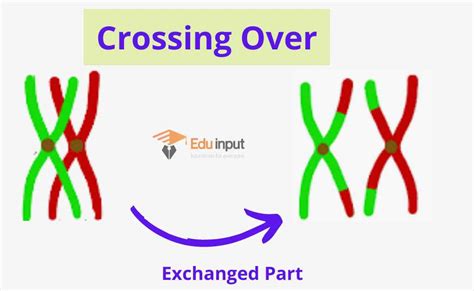
The phenomenon of “crossing over” has long fascinated scientists, offering a glimpse into the intricate processes that govern genetic diversity. This biological process, particularly prominent during meiosis, involves the exchange of genetic material between homologous chromosomes. Understanding crossing over not only enriches our knowledge of genetics but also holds substantial implications for fields like evolutionary biology and agriculture. Here, we delve into the intricacies of crossing over, providing expert insights that marry scientific rigor with practical applications.
Key Insights
- Crossing over during meiosis increases genetic variability, crucial for evolution.
- Technical understanding of crossing over aids in breeding programs.
- Practical applications include improving crop yields and disease resistance.
The Science Behind Crossing Over
Crossing over occurs during the prophase I of meiosis, when homologous chromosomes pair up and exchange segments of genetic material. This process introduces new combinations of alleles that were not present in either parent, thus fostering genetic diversity. This recombination is essential for evolutionary processes, allowing populations to adapt to changing environments by providing a broader genetic pool from which natural selection can act.The technical intricacies involve the formation of synapsis, where chromosomes line up and exchange segments at specific points called chiasmata. Each chiasma represents a location where genetic material has been swapped between homologous chromosomes, and these exchanges are often facilitated by enzymes such as recombinases that catalyze the necessary cuts and rejoins. The result is offspring with unique genetic traits that can enhance survival chances in various ecological niches.
Implications for Breeding and Agriculture
Across various sectors, the implications of crossing over are profound. In agriculture, understanding and harnessing this genetic recombination process can lead to significant advancements in breeding programs. By identifying and selecting favorable alleles during meiosis, breeders can develop crops with higher yields, improved nutritional value, and better resistance to diseases and pests. For instance, hybrid rice varieties that capitalize on crossing over have been engineered to offer better yields and pest resistance compared to traditional varieties.Another practical application is in the field of genetic research. Through techniques like genetic mapping, scientists can pinpoint the locations of genes responsible for specific traits on chromosomes. This knowledge is crucial for developing new biotechnological methods in genetic engineering, which can be used to produce transgenic organisms with desired characteristics. The principles of crossing over are thus not just academic—they have real-world applications that can address some of the world’s most pressing challenges in food security and biotechnology.
Can crossing over occur in mitosis?
Crossing over specifically occurs during meiosis, not mitosis. Mitosis is a process of cell division that results in two identical daughter cells, whereas meiosis reduces the chromosome number by half to produce four non-identical haploid cells, which includes the potential for crossing over.
What role does crossing over play in genetic disorders?
While crossing over is generally beneficial for genetic diversity, it can sometimes lead to genetic disorders if it occurs in the wrong context, particularly if it leads to unbalanced chromosomes. Such scenarios can occur in situations where there are abnormal numbers of chromosomes due to errors in meiosis, leading to conditions like Down syndrome.
Crossing over represents a fundamental aspect of genetic inheritance that has far-reaching implications in both biological research and practical applications. By deepening our understanding of this phenomenon, we can better appreciate the complex web of genetic interactions that sustain life and drive evolution.