Understanding what is a quadratic function is essential for anyone delving into algebra or higher-level mathematics. It’s a powerful concept that serves as the foundation for many applications in science, engineering, economics, and more. A quadratic function is an equation of the form (f(x) = ax^2 + bx + c), where (a), (b), and (c) are constants, and (a \neq 0). This guide will walk you through the essential concepts, practical examples, and common pitfalls associated with quadratic functions, providing actionable advice and problem-solving strategies to help you master this topic.
What You Need to Know About Quadratic Functions
Quadratic functions appear frequently in various mathematical problems and real-world applications. They describe parabolic relationships and are pivotal in understanding conic sections. When tackling quadratic equations, it’s crucial to be comfortable with completing the square, graphing parabolas, and finding their roots. This guide aims to simplify these complex aspects into manageable and actionable steps.
Quick Reference
Quick Reference
- Immediate action item: Graph a simple quadratic function like f(x) = x^2 to visualize its parabolic shape.
- Essential tip: Use the quadratic formula x = \frac{-b \pm \sqrt{b^2 - 4ac}}{2a} to find the roots of any quadratic equation.
- Common mistake to avoid: Confusing the coefficients a, b, and c, which can lead to incorrect calculations.
Breaking Down Quadratic Functions: From Basics to Advanced
To grasp the concept of quadratic functions, start by understanding their fundamental form and properties:
Defining the Quadratic Function
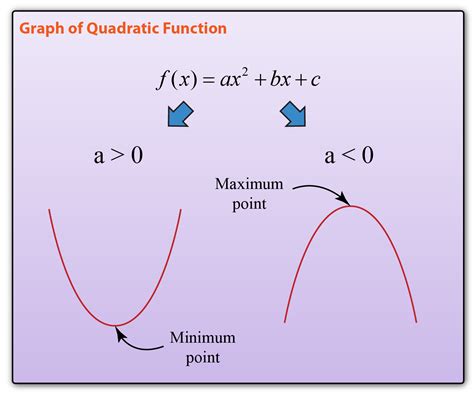
A quadratic function is expressed as (f(x) = ax^2 + bx + c). The value of (a) (where (a \neq 0)) determines whether the parabola opens upwards ((a > 0)) or downwards ((a < 0)). The parabola’s width is influenced by the absolute value of (a). The coefficients (b) and (c) affect the parabola’s position and vertex.
To see the function in action, consider f(x) = x^2, the simplest quadratic function, where a = 1, b = 0, and c = 0. Its graph is a parabola opening upwards with its vertex at the origin (0, 0).
Finding the Vertex of a Quadratic Function
The vertex of a quadratic function is its highest or lowest point, depending on whether the parabola opens downwards or upwards, respectively. To find the vertex, use the formula x = -\frac{b}{2a}. Substitute this x value back into the quadratic function to find the corresponding y-value. Let’s break down an example:
Consider f(x) = 2x^2 + 4x + 1. Here, a = 2, b = 4, and c = 1.
First, calculate the x-coordinate of the vertex:
x = -\frac{b}{2a} = -\frac{4}{2 \times 2} = -1
Now, substitute x = -1 back into the equation to find the y-coordinate:
f(-1) = 2(-1)^2 + 4(-1) + 1 = 2 - 4 + 1 = -1
Therefore, the vertex of the function f(x) = 2x^2 + 4x + 1 is at (-1, -1).
Graphing Quadratic Functions
Graphing a quadratic function involves plotting several points and connecting them to form a smooth curve. The vertex form of a quadratic equation is f(x) = a(x-h)^2 + k, where (h, k) is the vertex. This form is especially useful for graphing because it immediately shows the vertex of the parabola.
Consider the function f(x) = -3(x+2)^2 + 4.
Here, a = -3, h = -2, and k = 4. This tells us the vertex is at (-2, 4) and the parabola opens downwards because a < 0.
To graph, plot the vertex at (-2, 4) and calculate points on either side of the vertex. For example:
f(-3) = -3(-3+2)^2 + 4 = -3(1)^2 + 4 = 1
So, another point is (-3, 1). Similarly, calculate points for x = -1 and x = -2 to get a complete picture of the parabola:
| x | f(x) |
|---|---|
| -3 | 1 |
| -2 | 4 |
| -1 | 7 |
Solving Quadratic Equations: Practical Steps
Solving quadratic equations can be straightforward with the right approach. Let’s go through the methods step-by-step:
Factoring Quadratic Equations
Factoring involves expressing the quadratic equation in the form (x-p)(x-q) = 0, where p and q are the roots. Consider the equation x^2 - 5x + 6 = 0.
Find two numbers that multiply to 6 and add to -5. These numbers are -2 and -3.
Thus, factor the quadratic as:
x^2 - 5x + 6 = (x - 2)(x - 3) = 0
The solutions are x = 2 and x = 3.
Completing the Square
Completing the square transforms a quadratic equation into a form that makes it easier to solve. Take x^2 + 6x + 5 = 0.
Start by moving the constant term to the other side:
x^2 + 6x = -5
Next, add and subtract (\frac{b}{2})^2 = (\frac{6}{2})^2 = 9:
x^2 + 6x + 9 = -5 + 9
This simplifies to:
(x + 3)^2 = 4
Taking the square root of both sides gives:
x + 3 = \pm 2
Therefore, the solutions are x = -1 and x = -5.
Using the Quadratic Formula
For more complex equations that don’t factor easily, use the quadratic formula x = \frac{-b \pm \sqrt{b^2 - 4ac}}{2a}.
Consider 2x^2 + 4x - 3 = 0. Here, a = 2, b = 4, and c = -3.
First, calculate the discriminant:
b^2 - 4ac = 4^2 - 4(2)(-3) = 16 + 24 = 40
Then, plug these values into the quadratic formula:
x = \frac{-4 \pm \sqrt{40}}{4} = \frac{-4 \pm 2\sqrt{10}}{4} = \frac{-2 \pm \sqrt{10}}{2}
So, the solutions are x = \frac{-2 + \sqrt{10}}{2} and x = \frac{-2 - \sqrt{10}}{2}.
<