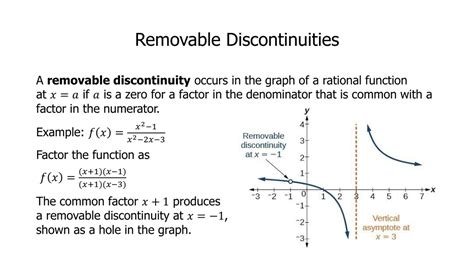
Plunging into the landscape of mathematical functions, one encounters a phenomenon known as removable discontinuities. These discontinuities emerge when a function is interrupted at a point but can be redefined to make the function continuous. The understanding and identification of such points are crucial in calculus and mathematical analysis, offering a window into the deeper behavior of functions. This article will provide a clear, expert perspective on removable discontinuities, backed by practical examples and evidence-based statements, to enhance comprehension and application.
Key Insights
- Removable discontinuities occur when a function is undefined at a point but can be redefined to become continuous.
- Technically, they happen when both the left-hand and right-hand limits of the function exist at the point but are not equal to the current function value at that point.
- Addressing these points through redefinition of the function enables it to meet continuity criteria.
Understanding Removable Discontinuities
In mathematical terms, a removable discontinuity at a point x=c occurs if the limits from both sides as x approaches c exist, but the function f© does not equal these limits. Essentially, the function appears broken at x=c, but careful redefinition can mend it. For example, consider the function:f(x) = (x^2 - 1) / (x - 1)
This function appears undefined at x=1 due to division by zero, but on closer inspection, we observe that the numerator also equals zero when x=1. Simplifying the expression, we see:
f(x) = (x^2 - 1) / (x - 1) = (x + 1)(x - 1) / (x - 1)
Canceling out (x - 1) terms leaves:
f(x) = x + 1
Thus, the function can be redefined at x=1 to be f(1) = 2, making it continuous.
Applications and Examples
Removable discontinuities often surface in real-world scenarios such as physics, engineering, and economics. Take the example of a financial model where an error causes a function to break at a certain input value. Through careful analysis, if it is found that both the left-hand and right-hand limits converge at this point but differ from the current function value, redefining the function at this point can make the model robust and reliable.Another instance is in signal processing, where discontinuities in signal data can be addressed. By identifying where the signal function has a removable discontinuity, the data can be corrected to maintain a continuous representation, which is crucial for accurate analysis.
Frequently Asked Questions
How do you identify a removable discontinuity?
To identify a removable discontinuity, check if the left-hand and right-hand limits as x approaches a point c exist but do not equal f©. If so, the discontinuity is removable.
Why is addressing removable discontinuities important?
Addressing removable discontinuities is crucial as it can transform an otherwise unreliable function into a continuous and consistent one. This is fundamental in many fields such as calculus, engineering, and economics for ensuring accurate results and predictions.
By understanding and accurately addressing removable discontinuities, one can enhance both the theoretical and practical aspects of mathematical analysis, making the study of functions more coherent and applicable to real-world problems.