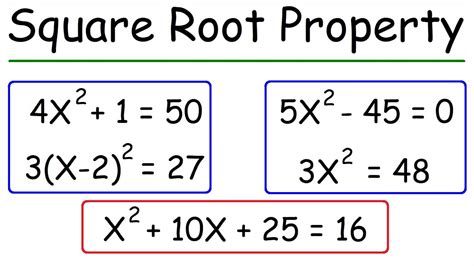
Understanding the square root property is crucial for solving quadratic equations efficiently. This guide will arm you with step-by-step guidance, practical examples, and real-world applications to master this essential mathematical concept.
Understanding the Square Root Property: A Problem-Solution Approach
Navigating through the world of quadratic equations can feel overwhelming, especially when you’re not sure of the best approach to solving them. The square root property is a powerful method used to find the solutions for equations of the form ax2 + bx + c = 0. This guide is designed to help you not only understand but also effectively apply the square root property to tackle your quadratic equation problems. By the end of this guide, you will have a deep comprehension of the process, alongside practical examples and strategies to help you apply this technique effortlessly.
Quick Reference
Quick Reference
- Immediate action item: Simplify the equation to the form x2 = k.
- Essential tip: Take the square root of both sides and remember to include the ± symbol.
- Common mistake to avoid: Forgetting to consider both positive and negative roots.
How to Apply the Square Root Property: Step-by-Step
The square root property is primarily used when an equation is simplified to a form where a squared term equals a constant (x2 = k). The steps below break down how to apply this property effectively:
Step-by-Step Application
To begin with, consider the general quadratic equation ax2 + bx + c = 0. The goal is to manipulate this equation so that it takes the form x2 = k. Here’s how you proceed:
-
Isolate the Quadratic Term: Move all non-quadratic terms to one side of the equation, so you are left with the quadratic term alone on the other side.
-
Divide by Coefficient: If a is not 1, divide every term by the coefficient ‘a’ to normalize the leading coefficient.
-
Complete the Square: To form the equation x2 = k, you may need to complete the square if necessary. This step involves adding and subtracting the square of half the coefficient of x on both sides of the equation.
-
Apply Square Root Property: Once the equation is in the form x2 = k, take the square root of both sides, remembering to include the ± symbol.
Let’s apply these steps with an example: Consider the equation x2 - 4x + 4 = 0.
- Step 1: The equation is already in a simplified form where a = 1, b = -4, and c = 4.
- Step 2: Here, no division is needed since a is already 1.
- Step 3: The equation is already in the perfect square form (x - 2)2 = 0.
- Step 4: Take the square root: x - 2 = 0 or x - 2 = 0. Solving these gives x = 2.
Deepening Your Understanding: Detailed Examples
To solidify your grasp of the square root property, let’s delve into some more complex examples.
Example 1: Basic Application
Let’s solve the equation x2 = 25.
- Step 1: Isolate the quadratic term: x2 = 25 is already in the right form.
- Step 2: Take the square root of both sides: x = ±√25.
- Solution: Hence, x = ±5.
Example 2: Completing the Square
Let’s solve the equation 2x2 - 8 = 0.
- Step 1: Move constant to the other side: 2x2 = 8.
- Step 2: Divide by the coefficient: x2 = 4.
- Step 3: Take the square root: x = ±√4.
- Solution: Hence, x = ±2.
Practical FAQ: Addressing Common User Pain Points
What if the equation does not readily fit the x2 = k form?
If an equation doesn’t directly fit the x2 = k form, you may need to complete the square. Here’s a refresher on how to do it:
- Start with an equation in the form ax2 + bx + c = 0.
- Isolate the x2 and x terms on one side.
- Divide every term by ‘a’ if ‘a’ is not 1.
- Calculate (b/2)2 and add it to both sides to complete the square.
- Rewrite the left side as a squared binomial and simplify.
- Apply the square root property.
Let’s take an example: Solve 4x2 - 12x = -9.
- Step 1: Rewrite as 4x2 - 12x + 9 = 0.
- Step 2: Divide by 4: x2 - 3x + 2.25 = -2.25.
- Step 3: Take square roots: x - 1.5 = ±√-2.25.
- Solution: Since √-2.25 is not a real number, this equation has no real solutions.
Advanced Tips and Best Practices
Once you’ve mastered the basics, here are a few tips and best practices to further refine your approach:
- Check your work: Always substitute your solutions back into the original equation to verify correctness.
- Practice with different coefficients: Try various quadratic equations with different values to gain fluency.
- Understand the discriminant: Familiarize yourself with the discriminant (b2 - 4ac) as it determines the nature of the roots.
- Visual aids: Use graphing tools to visualize the quadratic function and confirm your solutions.
Mastering the square root property not only enhances your problem-solving skills but also builds a foundation for more advanced topics in algebra and beyond. Happy solving!