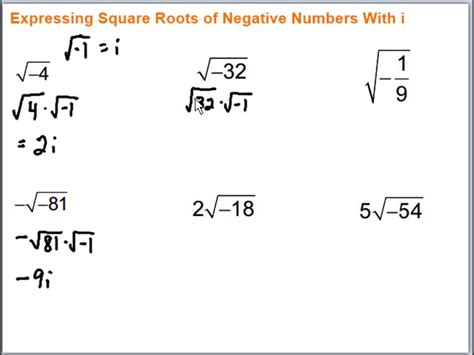
Welcome to the comprehensive guide on understanding the square root of negative numbers. If you've ever encountered a problem involving the square root of a negative number and felt baffled, you're not alone. This phenomenon may seem strange at first, but once you delve into it, it becomes fascinating and immensely useful in advanced mathematics and physics. This guide will take you through the steps, offering practical examples and problem-solving strategies to make sense of the square root of negative numbers. Whether you're a student tackling calculus or an enthusiast exploring complex numbers, this guide will equip you with the knowledge you need.
Problem-Solution Opening Addressing User Needs
Encountering a square root of a negative number can initially seem like an insurmountable problem. You might be solving an equation or analyzing a physics problem, only to hit a roadblock when you see something like √(-4) or √(-9). The first instinct might be to give up, but hold on—there’s a fascinating world of complex numbers waiting for you. This guide will break down these concepts step-by-step, providing actionable advice and practical solutions to demystify these seemingly impossible square roots. By the end of this guide, you’ll not only understand what it means but also be able to apply this knowledge in real-world scenarios.
Quick Reference
Quick Reference
- Immediate action item: Recognize when a square root involves a negative number. For instance, √(-4) can be identified easily.
- Essential tip: Use imaginary numbers, represented by ‘i’, where i = √(-1) to simplify expressions. For example, √(-4) = √(4 × -1) = √(4) × √(-1) = 2i.
- Common mistake to avoid: Confusing complex numbers with negative numbers in standard operations. Remember, ‘i’ squared equals -1.
Understanding the Square Root of Negative Numbers
To truly grasp the square root of negative numbers, we need to dive into the realm of complex numbers. A complex number combines a real number with an imaginary number. The general form is a + bi, where ‘a’ is the real part and ‘bi’ is the imaginary part. The letter ‘i’ represents the imaginary unit, defined as i = √(-1). Here’s a detailed step-by-step guide to understanding and using this concept.
Defining Imaginary Numbers
Imaginary numbers are the cornerstone of handling square roots of negative numbers. By introducing the imaginary unit ‘i’, we redefine square roots of negatives:
- √(-a) = √a * i where ‘a’ is a positive real number.
- For example, √(-9) = √9 * i = 3i.
This fundamental concept allows us to extend our number system beyond real numbers, incorporating complex numbers.
Exploring Complex Numbers
To work with complex numbers effectively, you need to understand their components:
- The real part: This is the first part of a complex number (a in a + bi).
- The imaginary part: This is the second part of a complex number (bi in a + bi).
For instance, in the complex number 3 + 4i, 3 is the real part, and 4i is the imaginary part.
Addition and Subtraction of Complex Numbers
Adding and subtracting complex numbers follows straightforward rules:
- To add: Add the real parts together and the imaginary parts together.
- To subtract: Subtract the real parts and the imaginary parts separately.
Example:
- If we have (3 + 4i) + (2 + 3i), we add the real parts: 3 + 2 = 5. We also add the imaginary parts: 4i + 3i = 7i. So, (3 + 4i) + (2 + 3i) = 5 + 7i.
- For subtraction, if we subtract (3 + 4i) from (2 + 3i), we get: 2 - 3 = -1 and 3i - 4i = -i. Therefore, (2 + 3i) - (3 + 4i) = -1 - i.
Multiplication and Division of Complex Numbers
Multiplication and division involve more intricate steps, but they follow specific patterns:
Multiplication:
To multiply two complex numbers, we use the distributive property:
- (a + bi)(c + di) = ac + adi + bci + bdi²
- Remember that i² = -1, so the expression simplifies.
Example:
- Let’s multiply (2 + 3i)(1 + 4i):
- Using distribution, we get: 2 * 1 + 2 * 4i + 3i * 1 + 3i * 4i
- Which simplifies to: 2 + 8i + 3i + 12i²
- Since i² = -1, this becomes: 2 + 11i + 12(-1)
- Simplifying further: 2 + 11i - 12 = -10 + 11i
Division:
To divide complex numbers, we rationalize the denominator:
- Multiply both the numerator and the denominator by the conjugate of the denominator.
Example:
- To divide (3 + 4i) by (1 + 2i), we multiply the numerator and denominator by the conjugate of the denominator (1 - 2i):
- (3 + 4i)(1 - 2i) / (1 + 2i)(1 - 2i)
- Simplifying the denominator: (1 + 2i)(1 - 2i) = 1² - (2i)² = 1 - 4(-1) = 1 + 4 = 5
- Simplifying the numerator: (3 + 4i)(1 - 2i) = 3 - 6i + 4i - 8i² = 3 - 2i - 8(-1) = 3 - 2i + 8 = 11 - 2i
- Therefore, (3 + 4i)/(1 + 2i) = (11 - 2i)/5 = 11⁄5 - 2i/5
Practical FAQ
Common user question about practical application
What are some real-world applications of complex numbers?
Complex numbers have a variety of practical applications in fields such as engineering, physics, and signal processing. For example:
- Electrical Engineering: Complex numbers are used to represent alternating current (AC) circuits, where voltages and currents are sinusoidal functions of time. The impedance of a circuit component, which incorporates both resistance and reactance, is often expressed in complex form.
- Signal Processing: In digital signal processing, complex numbers are used in Fourier transforms to analyze the frequency components of signals.
- Quantum Mechanics: Quantum states and wave functions are often represented using complex numbers, which allows for the description of superposition and interference phenomena.
Understanding complex numbers is essential for solving problems in these fields where the square root of negative numbers naturally appears.