Understanding the Sqrt Negative Number Math Mystery
In the realm of mathematics, encountering the square root of a negative number can initially seem like an enigma. Historically, the notion of the square root of a negative number was perplexing, until mathematicians introduced complex numbers to unravel this mystery. The concept of the square root of a negative number isn’t just a theoretical construct; it holds practical relevance in various fields, including engineering, physics, and even finance. To grasp this complex concept, let’s delve deeper into its intricacies.
Key Insights
- The square root of a negative number introduces the imaginary unit 'i', which simplifies complex calculations.
- The use of complex numbers in engineering ensures precise modeling of phenomena that exhibit oscillatory behavior.
- Understanding complex numbers is essential for mastering advanced topics in calculus and electrical engineering.
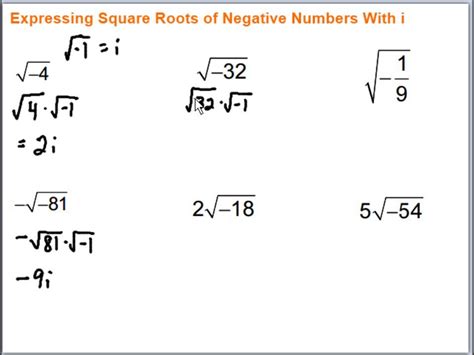
To understand the square root of a negative number, it’s vital to first recognize its theoretical foundation in complex numbers. Traditional real numbers extend from the negative to the positive infinity along a single line. However, when faced with the square root of a negative value, we extend this linear spectrum into the complex plane. This leap into the complex plane introduces the imaginary unit ‘i’, defined by the property that i^2 = -1. Therefore, the square root of a negative number, such as -4, can be expressed as 2i.
Complex numbers are written in the form a + bi, where ‘a’ is the real part and ‘b’ is the imaginary part. This form allows mathematicians to perform operations similar to those used for real numbers, yet now accommodates both real and imaginary components. Complex numbers are particularly useful in fields such as electrical engineering, where alternating current (AC) circuits exhibit oscillatory behavior. The impedance of a circuit, a measure of its opposition to a current, can be modeled using complex numbers, enabling engineers to calculate the effects of resistance, inductance, and capacitance with remarkable precision.
The introduction of complex numbers allows for a comprehensive analysis of sinusoidal functions, which are ubiquitous in AC circuits. Euler’s formula, e^(ix) = cos(x) + i sin(x), elegantly bridges the gap between exponential functions and trigonometric functions, both of which are fundamental in understanding wave phenomena. This formula highlights the intrinsic link between the exponential function and complex numbers, providing a powerful tool for analysis and synthesis in electrical engineering.
Beyond engineering, complex numbers also play a crucial role in advanced calculus. In calculus, they enable the extension of real number functions to the complex plane, where the fundamental theorem of algebra assures that every non-constant polynomial has at least one complex root. This insight is not just theoretical but also practical for solving differential equations that model real-world scenarios, such as heat transfer or wave propagation.
How do complex numbers apply in real-world engineering scenarios?
Complex numbers are instrumental in modeling and analyzing alternating current (AC) circuits. They allow engineers to calculate impedance, phase angles, and power in AC systems with precision, ensuring accurate and efficient design of electrical circuits and devices.
What is the significance of Euler’s formula in mathematics?
Euler’s formula e^(ix) = cos(x) + i sin(x) connects exponential functions and trigonometric functions, providing a powerful method for analyzing wave phenomena and oscillatory systems. This formula is foundational in both electrical engineering and quantum physics.
The exploration of the square root of negative numbers has paved the way for a more profound understanding of mathematics and its applications. As we venture deeper into this mathematical mystery, we uncover the elegance and utility of complex numbers, which continue to be pivotal in advancing technology and scientific discovery.