In the realm of mathematics, particularly in calculus and physics, converting between different coordinate systems is crucial for problem-solving. Among these conversions, changing from rectangular to polar coordinates stands out for its practical applications in various fields. Understanding this process not only broadens your mathematical toolset but also enhances your ability to solve real-world problems more efficiently.
Key Insights
- Rectangular coordinates are easier to understand for beginners but often harder to apply to problems involving circular motion.
- Polar coordinates provide a more intuitive representation for circular and periodic phenomena.
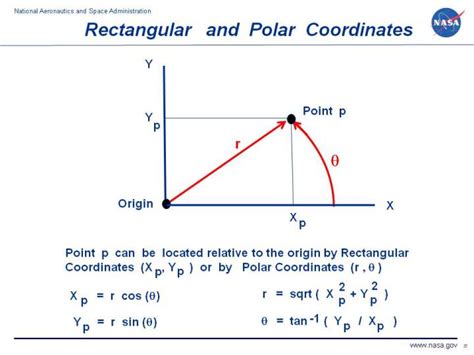
- To convert from rectangular to polar, use the formulas r = √(x² + y²) and θ = tan⁻¹(y/x).
To effectively grasp the concept of converting rectangular coordinates to polar coordinates, it’s essential to first understand the fundamental definitions and relationships between these two systems. In rectangular coordinates, any point in a plane is defined by an ordered pair (x, y) representing its horizontal and vertical distances from the origin. Conversely, in polar coordinates, a point is defined by a radius r and an angle θ, where r is the distance from the origin (the pole) and θ is the angle from the positive x-axis.
The mathematical basis for the conversion lies in the relationship between these two coordinate systems. The radius r in polar coordinates can be derived using the Pythagorean theorem. Specifically, r is calculated as the square root of the sum of the squares of x and y: r = √(x² + y²). This formula provides the distance from the origin to the point in question. The angle θ, on the other hand, is derived using trigonometry. It is calculated as the arctangent of the ratio of y to x: θ = tan⁻¹(y/x). This gives the angle the line makes with the positive x-axis, measured counterclockwise.
In practice, this conversion is particularly valuable in fields like engineering and physics, where problems often involve circular motion or waves. For instance, consider a point on a rotating system described by rectangular coordinates. Converting these to polar coordinates simplifies the problem by aligning with the natural circular motion, allowing for more straightforward analysis and computation.
Understanding the precise application of these conversion formulas can greatly enhance problem-solving efficiency. For example, suppose you are working on a project involving electromagnetic wave propagation, which naturally exhibits circular motion. Describing points in rectangular coordinates would complicate calculations involving distances and angles. By converting these points to polar coordinates, the wave’s propagation can be analyzed more directly and intuitively.
Can the θ value be negative?
Yes, the θ value can be negative if the point is located in the second or fourth quadrant of the Cartesian plane. This indicates that the angle is measured clockwise from the positive x-axis.
What should I do if x and y are both zero?
If x and y are both zero, the point lies at the origin. In this case, r is zero, and θ is undefined because dividing by zero is not possible. Practically, this represents a single point at the origin regardless of the angle.
In conclusion, converting from rectangular to polar coordinates is a fundamental skill with extensive practical applications. By understanding and utilizing the conversion formulas, you can simplify and solve complex problems involving circular motion and periodic phenomena more effectively.