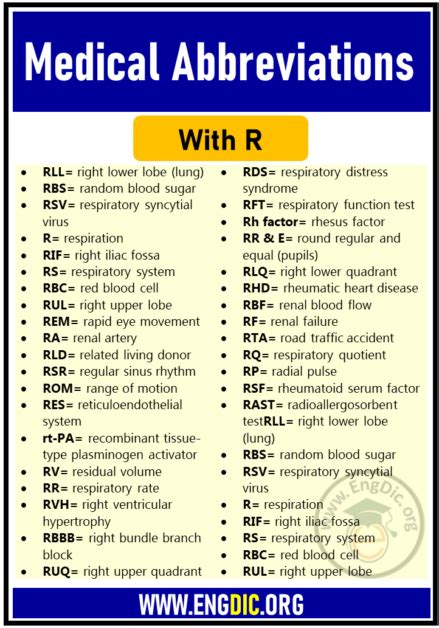
Decoding the r/o Medical Abbreviation: Your Essential Guide In the complex world of medical terminology, abbreviations are often used for efficiency and brevity. However, for those unfamiliar with medical jargon, these shorthand terms can be bewildering. One such abbreviation is “r/o,” which stands for “rule out.” In this article, we will decode the r/o medical abbreviation, offering practical insights and real examples to help you understand its use and significance in medical practice.
Key Insights
- Understanding “r/o” is crucial for grasping differential diagnoses in medical evaluations.
- This term emphasizes the process of eliminating potential diagnoses.
- Always verify the specific clinical context in which “r/o” is used to avoid misinterpretation.
Understanding the Term “Rule Out” in Medical Context
In medical practice, “rule out” is an essential part of differential diagnosis, where doctors systematically eliminate possible diagnoses until the most likely one is identified. The abbreviation “r/o” encapsulates this process efficiently. For instance, when a patient presents with symptoms like fever and cough, a physician might suspect pneumonia but might also need to rule out other conditions like bronchitis, influenza, or even a rare infection. The term “r/o” helps streamline communication among healthcare providers, ensuring that no potential diagnosis is overlooked.Practical Applications of “Rule Out” in Diagnosis
The application of “r/o” in medical diagnosis is widespread and varies depending on the specialty. For example, in pediatrics, a doctor might suspect asthma when a child presents with wheezing and a family history of respiratory conditions. However, they would also need to rule out other conditions such as vocal cord dysfunction or even allergies through a series of tests like spirometry and allergy panels. This systematic elimination process ensures that the final diagnosis is accurate and based on comprehensive evaluation.In cardiology, the use of “r/o” is frequent during the investigation of chest pain. A physician might initially suspect myocardial infarction (heart attack), but to rule out other causes like angina, gastroesophageal reflux disease (GERD), or even muscle strain, additional tests such as ECG, blood tests for cardiac markers, and possibly a stress test may be necessary. The meticulous process of “ruling out” other diagnoses prevents misdiagnosis and ensures appropriate treatment.
What does "r/o" mean in a medical report?
In medical reports, "r/o" stands for "rule out," indicating that the physician is systematically eliminating other potential diagnoses while investigating the primary concern.
Can "r/o" be used in all medical fields?
"R/o" is widely used across various medical fields, though its specific application may differ based on the specialty. It's particularly common in areas requiring differential diagnosis, such as internal medicine, pediatrics, and cardiology.
In conclusion, decoding the r/o medical abbreviation reveals a fundamental aspect of medical practice. It underscores the rigorous and systematic approach to diagnosis that healthcare providers adopt to ensure patient safety and accurate treatment. Always remember, “r/o” is a powerful tool in the physician’s arsenal, promoting thoroughness and precision in medical evaluations.