Understanding normal distribution percentages is crucial for leveraging powerful insights in data analysis. These percentages offer a clear picture of where data points lie within a dataset, allowing experts to make informed decisions based on statistical probability. This article aims to demystify the concept of normal distribution, providing practical insights and actionable recommendations for real-world applications.
Key Insights
- Normal distribution percentages help in understanding data spread and statistical significance.
- Technical applications include hypothesis testing and quality control.
- Utilize normal distribution percentages for improved predictive analytics.
Foundations of Normal Distribution
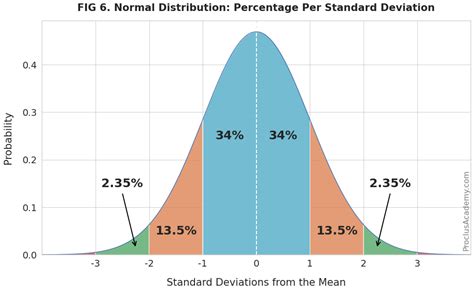
At its core, a normal distribution, often referred to as a bell curve, is a probability distribution that is symmetric around the mean, indicating that data near the mean are more frequent in occurrence than data far from the mean. This distribution is crucial in statistical analysis because it appears frequently in natural phenomena and is often used in quality control and measurement-based fields.
Understanding this fundamental concept allows professionals to interpret real-world data effectively. For instance, in quality control, a normal distribution can help determine the proportion of defective items in a batch by examining the spread around the mean, ensuring that only the acceptable items meet the standards.
Applications in Predictive Analytics
The real power of normal distribution percentages lies in their ability to enhance predictive analytics. For example, when 95% of a normally distributed dataset falls within two standard deviations from the mean, professionals can make confident predictions about future outcomes.
In the field of finance, analysts use normal distribution to assess risks and returns. By understanding the normal distribution of stock prices, analysts can determine the likelihood of certain market behaviors, helping to guide investment strategies.
Furthermore, in healthcare, normal distribution percentages can predict patient outcomes and treatment effectiveness. By analyzing data on patient responses to treatments, practitioners can better understand the efficacy of different medical interventions, leading to improved patient care.
How do I calculate a normal distribution percentage?
To calculate a normal distribution percentage, determine the mean and standard deviation of your dataset. Use these values to find the z-score for the data point of interest. Look up the corresponding area under the standard normal curve to find the percentage. Online statistical tools or software can also perform these calculations efficiently.
What is the importance of understanding normal distribution in decision-making?
Understanding normal distribution is vital for decision-making as it provides a clear understanding of data spread and probability. This knowledge enables you to make data-driven decisions by evaluating risks and outcomes effectively. For instance, in business, it aids in market analysis, while in healthcare, it supports treatment efficacy assessments.
This exploration of normal distribution percentages highlights their significant role in data analysis and decision-making. By comprehending the foundational principles and practical applications, professionals can harness these percentages to unlock powerful insights, ultimately leading to more informed and effective outcomes in their respective fields.