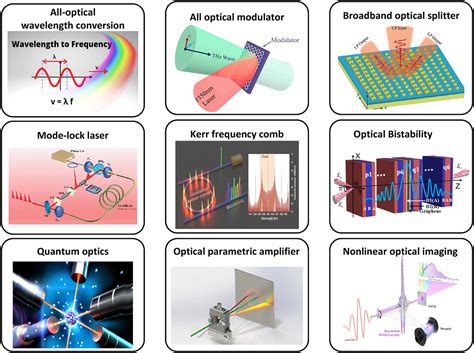
Nonlinear optical materials have emerged as a revolutionary field in the realm of photonics and quantum light research, unlocking the mysteries of light-matter interactions at quantum levels. These materials have unique properties that enable complex manipulations of light waves, resulting in applications that span telecommunications, high-precision measurements, and quantum computing.
Practically, nonlinear optical materials can alter light waves by changing their frequency, intensity, or phase in a nonlinear manner. This effect becomes evident when light passes through a material and interacts in a way that cannot be predicted by simple linear superposition. Understanding these interactions offers researchers and engineers a powerful toolkit for advancing technological capabilities.
Key Insights
- Nonlinear optical materials enable complex light wave manipulations.
- Their applications range from telecommunications to quantum computing.
- Research in this field provides actionable innovations for future technologies.
Understanding Nonlinear Optical Effects
Nonlinear optical effects, such as second-harmonic generation (SHG) and optical parametric processes, derive from the intrinsic properties of certain materials that do not follow a linear response to an applied electric field. These effects come into play when the intensity of the light is significantly high, prompting the material to respond in a nonlinear fashion. This unique behavior is primarily due to the material’s molecular structure and electronic properties.
For instance, materials such as potassium titanyl phosphate (KTP) and beta barium borate (BBO) are extensively used for SHG, where a laser beam passing through these materials is converted into a beam of light with twice the frequency. Such phenomena are crucial for applications like frequency doubling, which is essential for generating high-energy ultraviolet light for scientific experiments.
Applications in Quantum Computing and Telecommunications
One of the most promising fields for nonlinear optical materials is quantum computing. Here, these materials can help in developing components like quantum gates, which are essential for quantum bit (qubit) manipulation. The ability to control the phase, frequency, and intensity of light with precision paves the way for building more sophisticated quantum circuits.
In telecommunications, nonlinear optical materials play a pivotal role in enhancing the efficiency of data transmission. Techniques such as four-wave mixing (FWM) leverage these materials to increase bandwidth and reduce signal loss over long distances. For instance, deploying these materials in fiber optic networks can facilitate the creation of advanced optical switches and amplifiers, leading to higher data throughput and reliability.
What makes a material suitable for nonlinear optical applications?
A material's suitability for nonlinear optical applications depends on its ability to exhibit a significant nonlinear optical response under the influence of an applied electric field. Materials with high nonlinear optical coefficients, such as KTP and BBO, are often chosen because they can significantly alter light properties such as frequency, intensity, and phase.
How does research in nonlinear optical materials benefit everyday technologies?
Research in nonlinear optical materials directly contributes to advancements in everyday technologies, from improving data transmission speeds in telecommunications to enhancing the precision of measurements in medical diagnostics. Innovations in this field can lead to more efficient devices, better performance in quantum computing, and novel applications in imaging technologies.
Nonlinear optical materials continue to be an area of intense study and development. The ability to harness these materials for practical applications highlights the importance of continued research and innovation in this field, opening new avenues for technological advancement and scientific discovery.