The botanical world offers an array of fascinating insights, but two categories often generate considerable interest and debate among experts and enthusiasts alike: monocots and dicots. While these terms may seem esoteric, understanding the fundamental differences between monocots and dicots can greatly influence agricultural practices, plant identification, and ecological studies. This article delves into these key distinctions, bringing practical and evidence-based perspectives to the table.
Key Insights
- Monocots and dicots are two major categories of flowering plants with distinct anatomical and genetic traits.
- Monocots have a single seed leaf, while dicots develop two seed leaves.
- Effective knowledge of these differences can significantly aid in plant classification and agricultural management.
Monocots: The Single Leaf Seed Plants
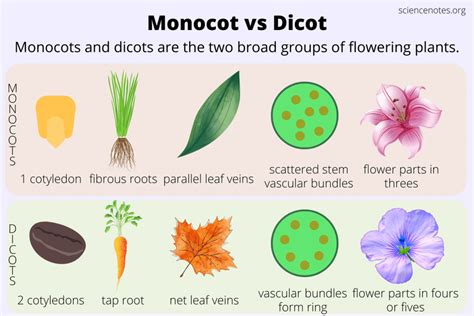
Monocots, short for monocotyledons, represent one of the two major groups of flowering plants. They are characterized by having a single cotyledon, or seed leaf, in their seeds. This unique trait leads to several notable features: monocots typically have parallel venation in their leaves, fibrous root systems, and three-part flower parts. A classic example of a monocot is the ubiquitous corn plant. The presence of fibrous roots enables many monocots to thrive in a wide range of environments, from wetland areas to arid deserts.Monocots include a vast array of plants, from staple crops like rice and wheat to decorative garden flowers like lilies. Understanding monocot traits can greatly enhance agricultural efficiency by enabling better crop rotation, soil management, and disease resistance strategies.
Dicots: The Two Leaf Seed Plants
Dicots, or dicotyledons, make up the other major plant category and are distinguished by having two cotyledons in their seeds. This feature contributes to various structural and functional characteristics. Dicots generally exhibit net-like (reticulate) leaf venation, a taproot system, and flower parts that are usually in multiples of four or five. A quintessential example is the sunflower, which clearly displays these traits. The taproot system found in dicots allows them to access deeper water sources, thereby offering resilience during dry spells.The dicot group includes many of the largest and most complex plants, ranging from small herbs to towering trees like oaks and maples. The diverse dicot ecosystem plays a crucial role in ecological dynamics, providing habitat and food for a myriad of species. Mastery of dicot characteristics facilitates improved forestry practices, urban landscaping, and biodiversity conservation efforts.
How can understanding monocots and dicots improve crop management?
Knowing the specific traits of monocots and dicots allows for tailored agricultural practices. For instance, crop rotation can be optimized by alternating between monocot and dicot crops to enhance soil health and reduce pest cycles.
Are there notable exceptions to the typical monocot and dicot characteristics?
While monocots and dicots generally follow distinct patterns, some species exhibit atypical traits due to genetic mutations or evolutionary adaptations. For instance, certain monocots can develop a taproot system under specific environmental pressures.
By delving into the fundamental differences between monocots and dicots, one can appreciate the intricate workings of plant biology while gaining practical tools for various applications. Whether you’re a seasoned botanist or an interested amateur, this knowledge opens a gateway to deeper understanding and more informed decision-making in plant studies and management.