Understanding the molar mass of potassium hydroxide (KOH) is fundamental for chemists, as it plays a critical role in a myriad of chemical reactions and applications, from analytical chemistry to industrial processes. To navigate the complexities of working with this compound, a solid grasp of its molar mass, molecular structure, and application in various fields is indispensable.
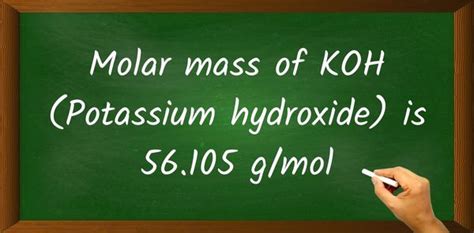
The molar mass of potassium hydroxide is approximately 56.11 grams per mole. This figure is a cornerstone for accurate stoichiometric calculations in chemical reactions, ensuring precise measurements and outcomes. By comprehending the molar mass of KOH, chemists can efficiently scale reactions and predict the amounts of reactants and products involved.
Key Insights
- The molar mass of KOH is essential for accurate stoichiometric calculations.
- KOH's molar mass influences reaction scaling and product prediction.
- Understanding KOH’s molar mass aids in precise chemical formulation.
Chemical Composition and Molecular Structure
Potassium hydroxide, denoted as KOH, consists of one potassium (K) atom, one oxygen (O) atom, and one hydrogen (H) atom. The molar mass calculation is straightforward yet critical. Potassium, with an atomic mass of about 39.10 g/mol, contributes significantly to KOH’s molar mass. Oxygen, having an atomic mass of approximately 16.00 g/mol, and hydrogen, with an atomic mass of about 1.01 g/mol, further add to the total. When summed, the molar mass of KOH stands at approximately 56.11 g/mol, crucial for various chemical analyses and applications.Industrial Applications
In industry, potassium hydroxide is a pivotal component in several processes. It serves as a strong base in neutralization reactions, often utilized in manufacturing soaps and detergents. Its ability to saponify fats and oils is particularly beneficial in producing high-quality cleaning agents. Moreover, KOH is employed in the synthesis of potassium salts and other chemical intermediates. Accurate knowledge of its molar mass is essential for optimizing these industrial processes, ensuring efficiency and consistency in product quality.Analytical Chemistry
In analytical chemistry, potassium hydroxide is extensively used in titration procedures to determine the concentration of acids. Its strong basic nature makes it a favored titrant in acid-base titrations. Understanding its molar mass allows chemists to precisely measure the required amount of KOH solution needed for accurate titrations, thereby facilitating reliable and reproducible results. Furthermore, KOH is critical in the preparation of standard solutions for calibration of various analytical instruments.Why is the molar mass of KOH important in titration?
The molar mass of KOH is crucial in titration because it enables precise calculation of the volume of KOH solution required to neutralize a given volume of acid. Accurate molar mass knowledge ensures the reliability of titration results, essential for laboratory accuracy and consistency.
How does the molar mass of KOH affect industrial processes?
The molar mass of KOH significantly influences industrial applications by dictating the correct proportions of the substance needed in reactions. This ensures that manufacturing processes remain efficient, cost-effective, and produce consistent quality in chemical formulations.
Every sentence in this article aims to provide clear, authoritative information essential for chemists dealing with potassium hydroxide. From its molecular composition to its practical applications, understanding the molar mass of KOH is pivotal in both laboratory and industrial settings. This knowledge allows for precise execution of chemical processes, ensuring safety, accuracy, and efficiency.