The logical structure we all rely on in critical thinking and reasoning has profound implications across various fields, from philosophy to everyday decision-making. One fundamental logical rule that plays a crucial role in this framework is the Law of Syllogism. This principle helps us understand how to derive conclusions from premises in a logically sound manner. This article delves into the intricacies of the Law of Syllogism, providing practical insights for both novices and experts.
Key Insights
- The Law of Syllogism is a cornerstone of logical reasoning, ensuring conclusions follow naturally from premises.
- Understanding this rule helps in crafting valid arguments across various disciplines.
- Implementing the Law of Syllogism can greatly enhance analytical skills in both academic and professional settings.
Understanding the Law of Syllogism
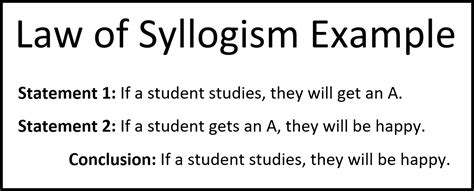
The Law of Syllogism is an essential concept in deductive logic. Simply put, it states that if proposition A implies proposition B, and proposition B implies proposition C, then proposition A logically implies proposition C. The classical form of the syllogism is: If P, then Q; and if Q, then R; therefore, if P, then R. This principle is widely applicable, making it a valuable tool in logic, mathematics, and various disciplines that demand rigorous analytical skills.Application in Everyday Reasoning
Consider the real-world example of traffic regulations: If a person commits a traffic violation (P), then they will receive a ticket (Q); and if they receive a ticket (Q), then they incur a fine ®. Therefore, if a person commits a traffic violation (P), they will incur a fine ®. This chain of reasoning illustrates the practical application of the Law of Syllogism. The ability to construct and deconstruct such logical sequences is crucial for decision-making and problem-solving in professional contexts.Technical Consideration in Formal Logic
From a technical perspective, the Law of Syllogism is crucial in formal logic and symbolic reasoning. In propositional logic, it is denoted as follows: (P → Q) ∧ (Q → R) → (P → R). This formal expression underscores the rule’s validity across various logical structures. When working with formal proofs or algorithmic logic in computer science, understanding and applying the Law of Syllogism ensures that derived conclusions are logically consistent and valid.What distinguishes the Law of Syllogism from other logical rules?
The Law of Syllogism specifically focuses on deriving a new conclusion from two given premises, emphasizing the logical flow from one implication to another. Unlike rules like the Law of Detachment or the Law of Contraposition, it involves a chain of implications rather than a direct inference.
Is the Law of Syllogism applicable in non-technical fields?
Absolutely, the Law of Syllogism is widely applicable beyond technical fields. It’s used in everyday reasoning, legal arguments, ethical discussions, and even in artistic critiques. Understanding and applying this rule helps ensure that conclusions drawn are logically sound.
Understanding the Law of Syllogism is not just an academic exercise but a practical tool that enhances our ability to reason and analyze effectively. This logical principle provides a solid foundation for constructing sound arguments and making informed decisions in both professional and personal contexts. By mastering the Law of Syllogism, individuals can elevate their analytical skills, leading to more robust and credible outcomes.