Understanding the Labor Force Formula: A Practical Guide for Everyone
The labor force formula is a fundamental concept for anyone interested in workforce dynamics, whether you’re a business owner, a policy maker, or just someone curious about economic trends. Often, the concept can be a bit abstract, leading to misconceptions and misinterpretations. This guide aims to break down the labor force formula into simple, actionable steps. By the end, you’ll not only understand this formula but be able to use it effectively to solve real-world problems and inform decisions. We’ll start with an introductory overview, followed by a quick reference guide to give you the essentials on the go, then delve into detailed sections to explain the formula and how to apply it. Finally, we’ll address frequently asked questions to ensure you’re fully equipped with knowledge and confidence.
Let's dive right in and see how you can master this essential economic tool.
Quick Reference: Labor Force Formula Essentials
Quick Reference
- Immediate action item: Calculate your current labor force participation rate to understand your workforce dynamics. This involves determining the ratio of the labor force to the total adult population.
- Essential tip: To calculate the labor force, sum up the number of employed individuals plus those actively seeking employment. This provides a clear picture of your active workforce.
- Common mistake to avoid: Don’t confuse the labor force participation rate with the unemployment rate. The former measures the active workforce, while the latter measures only those unemployed but not all those not working.
Breaking Down the Labor Force Formula
The labor force formula is designed to measure the active participation of an economy’s working-age population. It’s crucial for understanding economic activity and planning for future workforce needs. Let’s break down each component in detail.
Understanding the Components
The labor force is composed of two main parts: the employed and the unemployed. To calculate the labor force, follow these steps:
- Step 1: Identify the number of employed individuals. This includes anyone who has a job and is working or has a job but is temporarily absent (like on vacation).
- Step 2: Identify the number of individuals who are unemployed. These are people who do not have a job but are actively seeking one and are available for work.
- Step 3: Add the numbers from Step 1 and Step 2 to get the total labor force.
Calculating the Labor Force Participation Rate
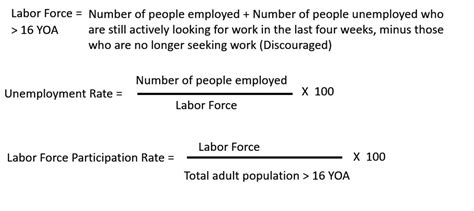
The labor force participation rate tells us what percentage of the working-age population is either employed or actively seeking employment. To calculate this, use the following formula:
Participation Rate = (Labor Force / Civilian Non-institutional Population) x 100%
Here’s what each part means:
- Labor Force: The total number of employed plus the number of unemployed who are actively seeking work.
- Civilian Non-institutional Population: The total number of people aged 16 and older, excluding those in institutions (like prisons).
This rate gives a clear snapshot of how active the labor market is in your area.
Practical Application of the Labor Force Formula
Let’s explore how to apply the labor force formula in real-world scenarios. Understanding this can help you make more informed decisions in both personal and business contexts.
Scenario 1: Small Business Owner
Imagine you’re a small business owner looking to understand the employment dynamics in your area. Here’s how you can apply the labor force formula:
- Step 1: Determine the number of employees you currently have working at your business.
- Step 2: Identify any employees who are currently unemployed but are part of your organization’s workforce plan. For example, someone who has recently left and is in the process of transitioning back.
- Step 3: Use local labor statistics to determine the number of people in your community who are unemployed and actively seeking work.
- Step 4: Combine the numbers from Steps 1 and 2 to get your total labor force. Then, to find the participation rate, divide by the total working-age population and multiply by 100%.
This can help you understand the available talent pool and plan your staffing needs accordingly.
Scenario 2: Policy Maker
For policymakers, understanding the labor force is essential for creating effective labor market policies and economic plans. Here’s how you can leverage the labor force formula:
- Step 1: Collect data on employment and unemployment within your region or country.
- Step 2: Calculate the total labor force using the steps outlined previously.
- Step 3: Determine the working-age population, typically everyone aged 16 and older.
- Step 4: Use the formula to calculate the labor force participation rate. This data can guide initiatives to encourage higher participation rates and support job creation efforts.
Scenario 3: Academic Researcher
Researchers can use the labor force formula to study trends and economic conditions over time. Follow these steps:
- Step 1: Gather historical data on employment and unemployment rates.
- Step 2: Compute the labor force for each time period.
- Step 3: Calculate the labor force participation rate using the total working-age population for each period.
- Step 4: Analyze the trends over time to identify significant changes or patterns, which can inform theoretical models or economic forecasts.
FAQ: Answers to Your Common Questions
Why is it important to understand the labor force formula?
Understanding the labor force formula is crucial for multiple reasons. It helps in:
- Business Planning: Companies can plan their staffing needs and understand potential recruitment challenges.
- Economic Analysis: Economists use this formula to gauge the health of the economy and predict future economic trends.
- Policy Making: Governments can develop effective labor market policies by understanding participation rates and employment trends.
Overall, it’s a vital tool for understanding workforce dynamics and ensuring efficient use of resources.
How often should I calculate the labor force?
The frequency of calculating the labor force depends on your specific needs. For businesses, quarterly or annual reviews can be sufficient. For policy makers, monthly or quarterly updates can help track changes more closely. Researchers typically use historical data as needed for their studies.
What if I don’t have access to current labor statistics?
If current data is unavailable, consider using historical data to estimate trends. You can also seek out local economic development offices or government websites that publish labor statistics regularly. Alternatively, industry reports from organizations like the Bureau of Labor Statistics (BLS) can provide reliable data.
By understanding and applying the labor force formula, you’re better equipped to navigate and make informed decisions about workforce dynamics in any context. From a small business to a national policy, this tool offers valuable insights to optimize and plan effectively.