Understanding and mastering Jordan Canonical Form is essential for anyone delving into linear algebra, particularly in the context of solving systems of linear differential equations or analyzing the behavior of linear transformations. This guide provides a step-by-step approach to grasping this complex concept, filled with actionable advice, real-world examples, and practical solutions.
Jordan Canonical Form, often referred to as Jordan form, is a powerful tool used to understand the structure of linear operators on vector spaces. It reveals the geometric and algebraic multiplicity of eigenvalues and how they influence the dynamics of the linear transformation. However, navigating through its intricacies can be challenging without the right guidance.
Step-by-Step Guidance on Jordan Canonical Form
The primary goal here is to demystify Jordan Canonical Form by breaking down its concepts into digestible parts. Let’s start with a problem-solving approach addressing common user pain points.
Many learners find the process of finding the Jordan Canonical Form overwhelming due to its abstract nature and computational complexity. The confusion often stems from understanding how to diagonalize a matrix, recognizing generalized eigenvectors, and constructing the Jordan blocks.
Our journey begins by addressing the fundamental steps and then moving on to more advanced techniques. By the end, you’ll be equipped with the knowledge and tools to tackle Jordan Canonical Form problems efficiently.
Quick Reference
Quick Reference
- Immediate action item: Identify eigenvalues and compute their algebraic multiplicity.
- Essential tip: Calculate the geometric multiplicity and determine the chain of generalized eigenvectors for each eigenvalue.
- Common mistake to avoid: Forgetting to check the size of Jordan blocks for each eigenvalue; they should match the algebraic multiplicity.
Detailed How-To Sections
Finding Eigenvalues and Their Multiplicities
To begin with, we need to find the eigenvalues of a given matrix A. This is the foundational step in determining the Jordan Canonical Form.
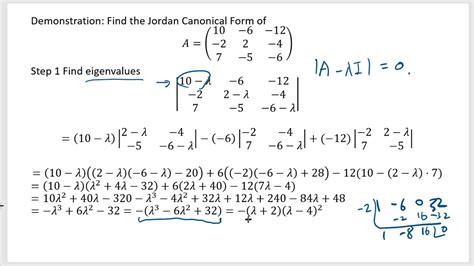
Start by solving the characteristic equation det(A - λI) = 0, where λ represents the eigenvalue and I is the identity matrix of the same dimension as A. The solutions to this equation are the eigenvalues of matrix A. The algebraic multiplicity of an eigenvalue λ is the number of times λ appears as a root of the characteristic polynomial.
Consider a simple 3x3 matrix:
Matrix A:
- A = [[4, 1, 0], [0, 4, 1], [0, 0, 4]]
To find the eigenvalues, solve the characteristic equation det(A - λI) = 0:
- A - λI = [[4-λ, 1, 0], [0, 4-λ, 1], [0, 0, 4-λ]]
- det(A - λI) = (4-λ)^3
- Set (4-λ)^3 = 0, the solution is λ = 4 with algebraic multiplicity 3.
Determining Geometric Multiplicity
The geometric multiplicity of an eigenvalue is the dimension of the eigenspace corresponding to that eigenvalue. This is essentially the number of linearly independent eigenvectors associated with the eigenvalue.
To find the geometric multiplicity, solve (A - λI)x = 0 for each eigenvalue λ. The number of linearly independent solutions to this equation gives you the geometric multiplicity.
For our matrix A:
- Eigenvalue λ = 4, solve (A - 4I)x = 0:
- (A - 4I) = [[0, 1, 0], [0, 0, 1], [0, 0, 0]]
- Find the null space of (A - 4I) to determine the eigenvectors:
- This reveals that the geometric multiplicity of λ = 4 is 1.
Identifying Generalized Eigenvectors and Jordan Chains
If the geometric multiplicity is less than the algebraic multiplicity, we need to find generalized eigenvectors. These are crucial for forming Jordan chains and constructing the Jordan blocks.
The idea is to find vectors that satisfy (A - λI)^kx = 0 for k > 1. These vectors will form the higher-order components of our Jordan chains.
For our matrix A:
- Eigenvalue λ = 4:
- Solve (A - 4I)^2x = 0 to find the generalized eigenvectors. Here, (A - 4I)^2 = [[0, 0, 1], [0, 0, 0], [0, 0, 0]]
- The solution reveals that the only solution is the zero vector, indicating we need another vector to form a chain.
- Try (A - 4I)x = v, where v is an eigenvector. This will give us the generalized eigenvector for our Jordan chain.
Constructing Jordan Blocks
The final step is to organize our eigenvectors and generalized eigenvectors into Jordan blocks. Each block corresponds to an eigenvalue and its associated chain of generalized eigenvectors.
The size of each Jordan block corresponds to the length of the chain of generalized eigenvectors associated with that eigenvalue. A block’s size is always at least one (for an eigenvector) and never exceeds the algebraic multiplicity of the eigenvalue.
For matrix A:
- We have one eigenvector (geometric multiplicity 1) and two generalized eigenvectors forming a chain.
- Construct a single Jordan block for λ = 4 with size 3:
- The Jordan form J of A is:
- J = [[4, 1, 0], [0, 4, 1], [0, 0, 4]]
Converting Back to Matrix Form
Once we have the Jordan blocks, we need to find the transformation matrix P such that A = PJP^-1. This involves finding the matrix whose columns are the generalized eigenvectors arranged in the correct Jordan chain order.
For our example, the columns of P will be the eigenvector and the two generalized eigenvectors:
- P = [[1, 0, 0], [0, 1, 1], [0, 0, 1]]
We then compute P^-1 to find the inverse and ensure A = PJP^-1 holds.
Practical FAQ
How do I know if my Jordan form is correct?
To verify your Jordan form, check if it satisfies A = PJP^-1 where P consists of the columns as your generalized eigenvectors. Additionally, ensure each Jordan block’s size matches the algebraic multiplicity of its associated eigenvalue. If A = PJP^-1 holds and the construction aligns with the eigenvalues’ multiplicities, your Jordan form is correct.
What if I encounter a matrix that cannot be put into Jordan form?
Not all matrices can be transformed into a Jordan Canonical Form, especially those that are defective, meaning they have some eigenvalues with algebraic multiplicity greater than their geometric multiplicity but no corresponding generalized eigenvectors. In such cases, the best you can achieve is a quasi-Jordan form or use other canonical forms like the RationalCanonical form or Companion form.
By following these detailed steps, you’ll be well-equipped to navigate the Jordan Canonical Form and leverage it for your linear algebra needs. Each section builds upon the last, ensuring a clear and logical progression