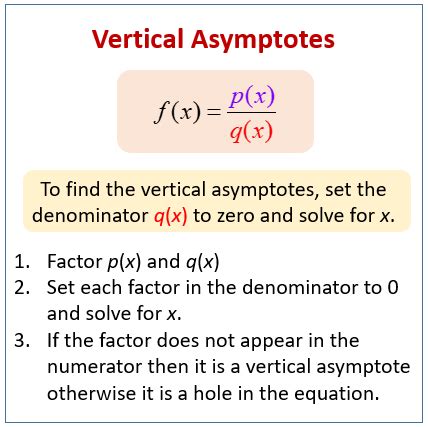
Finding vertical asymptotes in calculus is a fundamental skill that will aid you in understanding the behavior of functions as they approach certain values. Vertical asymptotes occur in rational functions where the function’s value grows indefinitely as it approaches a certain x-value. This guide will provide you with step-by-step guidance, actionable advice, and real-world examples to help you master this concept.
Understanding Vertical Asymptotes
A vertical asymptote is a vertical line that a function approaches but never touches. It typically occurs in rational functions, which are ratios of two polynomials. When the denominator of a rational function is zero (while the numerator is not zero), you have a vertical asymptote at that x-value.
This concept is crucial because it allows you to understand the boundaries within which a function behaves unpredictably. It helps you identify intervals where a function might not be useful or where it might be undefined. Knowing how to find these asymptotes will deepen your comprehension of a function’s behavior.
Quick Reference
Quick Reference
- Immediate action item: Set the denominator of a rational function to zero to find potential vertical asymptotes.
- Essential tip: Cancel common factors between the numerator and denominator before determining asymptotes, as this can affect the final result.
- Common mistake to avoid: Ignoring the domain restrictions of a function. If the function is not defined at a particular x-value, it’s likely an asymptote.
How to Identify Vertical Asymptotes
To find vertical asymptotes, follow these steps:
Step 1: Determine the Function Type
First, identify if you are working with a rational function. Rational functions have the form f(x) = p(x)/q(x), where p(x) and q(x) are polynomials and q(x) ≠ 0.
Step 2: Set the Denominator Equal to Zero
Locate the denominator of the rational function and set it equal to zero to find the potential x-values of vertical asymptotes.
For example, consider the function:
f(x) = (2x + 3) / (x^2 - 4)
Set the denominator to zero:
x^2 - 4 = 0
Solve the equation for x:
x^2 = 4
x = ±2
Step 3: Exclude Points Where the Numerator is Also Zero
If the numerator is also zero at the same x-value, then this does not create a vertical asymptote. To check this:
Evaluate the numerator at x = ±2:
For x = 2: 2(2) + 3 = 7 ≠ 0
For x = -2: 2(-2) + 3 = -1 ≠ 0
Both x = 2 and x = -2 are valid candidates for vertical asymptotes because the numerator is not zero at these points.
Step 4: Verify the Exclusion of Holes
Check if there are any common factors in the numerator and denominator that cancel out. These points are “holes” in the graph, not asymptotes.
In this example, there are no common factors between the numerator and the denominator, so x = 2 and x = -2 are vertical asymptotes.
Step 5: Write Down the Vertical Asymptotes
Summarize the findings:
For f(x) = (2x + 3) / (x^2 - 4), the vertical asymptotes are x = 2 and x = -4.
Step 6: Graph the Function
To visualize the vertical asymptotes, graph the function and draw the vertical lines at x = 2 and x = -4.
Practical Example: A Complex Rational Function
Let’s consider a more complex rational function:
f(x) = (3x^2 - 4x + 1) / (x^3 - x)
Step 1: Factor the Numerator and Denominator
First, factor both the numerator and the denominator:
Numerator: 3x^2 - 4x + 1
Denominator: x^3 - x = x(x^2 - 1) = x(x - 1)(x + 1)
Step 2: Identify Zero Points
Set the denominator equal to zero and solve for x:
x(x - 1)(x + 1) = 0
x = 0, x = 1, x = -1
Step 3: Cancel Common Factors
Check if there are common factors to cancel:
Numerator factors: 3x^2 - 4x + 1
Denominator factors: x(x - 1)(x + 1)
There are no common factors, so proceed to step 4.
Step 4: Determine Vertical Asymptotes
Vertical asymptotes occur where the denominator is zero and the numerator is not zero. Evaluate the numerator at each zero point of the denominator:
For x = 0: 3(0)^2 - 4(0) + 1 = 1 ≠ 0
For x = 1: 3(1)^2 - 4(1) + 1 = 0
For x = -1: 3(-1)^2 - 4(-1) + 1 = 8 ≠ 0
Step 5: List the Vertical Asymptotes
From the analysis:
f(x) has vertical asymptotes at x = -1 (since the numerator is not zero) and does not have an asymptote at x = 0 or x = 1.
Practical FAQ
How do I handle functions with common factors?
When there are common factors, cancel them out to simplify the function. The points where the canceled factor would have been zero are “holes” rather than vertical asymptotes. If the remaining denominator is zero at some x-value and the simplified numerator is not zero, those are the vertical asymptotes.
For example, consider the function:
f(x) = (2x^2 + 4x) / (x^2 + 2x)
Factor the numerator and denominator:
Numerator: 2x(x + 2)
Denominator: x(x + 2)
Cancel common factors:
f(x) = 2x/x = 2
No vertical asymptote exists because the original function has a hole at x = 0, but the simplified function is a constant.
What if the function’s denominator is a product of multiple factors?
If the denominator is a product of multiple factors, you find zeros for each factor individually. Evaluate the numerator at each zero to determine if a vertical asymptote exists:
For example, consider the function:
g(x) = (x^2 + 5x + 6) / (x^2 - 5x + 6)
Factor the numerator:
Numerator: (x + 2)(x