When delving into the intricacies of molecular structure and bonding, understanding formal charge becomes essential. Formal charge is a theoretical tool that helps chemists determine the distribution of electrons in molecules and helps in identifying resonance structures. This guide will walk you through the easy steps to find formal charge, providing actionable advice and practical solutions.
Let's dive right in, addressing a common challenge that many chemists face: accurately calculating the formal charge of atoms within a molecule. Formal charge calculations might seem daunting at first, but with a clear method, they become straightforward and valuable in understanding molecular stability and reactions.
Understanding Formal Charge
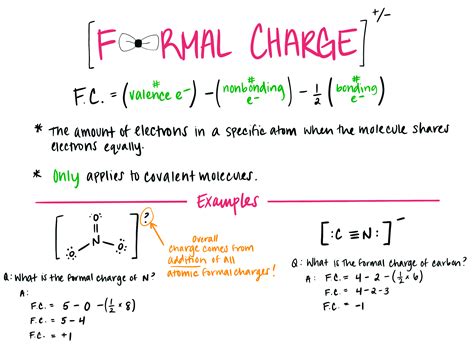
Formal charge is defined as the difference between the number of valence electrons an atom has in an isolated (free) state and the number of electrons assigned to it in a molecule. The formula for calculating formal charge is:
Formal Charge = (Valence Electrons) - (Non-bonding Electrons) - (1/2 × Bonding Electrons)
This calculation is instrumental in determining the best Lewis structure for a molecule, particularly when considering resonance forms.
Quick Reference
Quick Reference
- Immediate action item with clear benefit: Use Lewis structures to visualize and identify valence electrons for each atom.
- Essential tip with step-by-step guidance: Draw the molecule’s Lewis structure, ensuring all valence electrons are accounted for.
- Common mistake to avoid with solution: Do not overlook lone pair and shared pair electrons when calculating the formal charge.
Detailed Steps to Calculate Formal Charge
Let’s break down the formal charge calculation into manageable steps, starting from understanding the molecule’s Lewis structure to finding the formal charge for each atom.
Step 1: Draw the Lewis Structure of the Molecule
Begin by sketching the Lewis structure for the molecule in question. Ensure that you correctly represent the connectivity of atoms and distribute the valence electrons appropriately. Pay attention to double and triple bonds. Here’s a practical example: Let's consider formaldehyde (CH2O).
Step 2: Count Valence Electrons for Each Atom
Identify the valence electrons for each atom. For instance:
- Carbon (C) has 4 valence electrons.
- Hydrogen (H) has 1 valence electron each.
- Oxygen (O) has 6 valence electrons.
Step 3: Identify Lone Pair and Bonding Electrons
Examine the Lewis structure to determine the non-bonding (lone pair) electrons and the bonding electrons shared in the molecule. For formaldehyde:
- Carbon is bonded to two hydrogens and one oxygen.
- Each hydrogen has no lone pairs.
- The oxygen atom has two lone pairs and is bonded to carbon.
Step 4: Calculate Formal Charge for Each Atom
Apply the formal charge formula for each atom:
- For Carbon:
- Valence electrons = 4
- Non-bonding electrons = 0
- Bonding electrons = 2 (bond to oxygen) + 4 (bonds to hydrogens) = 6
- Formal Charge = 4 - 0 - (1/2 × 6) = 4 - 0 - 3 = +1
- For Hydrogen:
- Valence electrons = 1
- Non-bonding electrons = 0
- Bonding electrons = 2
- Formal Charge = 1 - 0 - (1/2 × 2) = 1 - 0 - 1 = 0
- For Oxygen:
- Valence electrons = 6
- Non-bonding electrons = 4 (two lone pairs)
- Bonding electrons = 2
- Formal Charge = 6 - 4 - (1/2 × 2) = 6 - 4 - 1 = -1
Step 5: Verify the Sum of Formal Charges
The sum of all formal charges in a molecule should equal the charge of the overall molecule. For neutral molecules, this sum should be zero. For charged molecules, it should equal the net charge.
Practical Example: Sulfur Dioxide (SO2)
Let’s apply these steps to sulfur dioxide, a molecule with slightly more complexity than formaldehyde.
Step 1: Draw the Lewis Structure of SO2
Sulfur has 6 valence electrons, and each oxygen has 6 valence electrons. Sulfur forms a double bond with one oxygen and a single bond with the other oxygen.
Step 2: Count Valence Electrons for Each Atom
- Sulfur (S) has 6 valence electrons.
- Each Oxygen (O) has 6 valence electrons.
Step 3: Identify Lone Pair and Bonding Electrons
- Sulfur forms a double bond with one oxygen and a single bond with another oxygen.
- Each oxygen atom has two lone pairs.
Step 4: Calculate Formal Charge for Each Atom
- For Sulfur:
- Valence electrons = 6
- Non-bonding electrons = 0
- Bonding electrons = 4 (2 from the double bond and 2 from the single bond)
- Formal Charge = 6 - 0 - (1⁄2 × 4) = 6 - 0 - 2 = +1
- For Oxygen (double bonded):
- Valence electrons = 6
- Non-bonding electrons = 4 (two lone pairs)
- Bonding electrons = 4 (double bond)
- Formal Charge = 6 - 4 - (1⁄2 × 4) = 6 - 4 - 2 = 0
- For Oxygen (single bonded):
- Valence electrons = 6
- Non-bonding electrons = 6 (three lone pairs)
- Bonding electrons = 2 (single bond)
- Formal Charge = 6 - 6 - (1⁄2 × 2) = 6 - 6 - 1 = -1
Step 5: Verify the Sum of Formal Charges
The sum of all formal charges should equal zero, as SO2 is a neutral molecule. Here:
- Sulfur (+1) + Oxygen (0) + Oxygen (-1) = 0
Practical FAQ
What if I find the formal charges do not add up to zero?
If the sum of formal charges does not equal zero for a neutral molecule, re-evaluate your Lewis structure and formal charge calculations. Ensure no electrons have been miscounted, especially in lone pairs and bonds.
For ions, remember that the sum of formal charges should equal the net charge of the ion. If this is not the case, review the distribution of electrons in the molecule.
Can formal charge help in predicting molecule stability?
Yes, formal charge can provide insight into the stability of a molecule. Molecules with more even distribution of formal charges are often more stable. Also, if atoms have formal