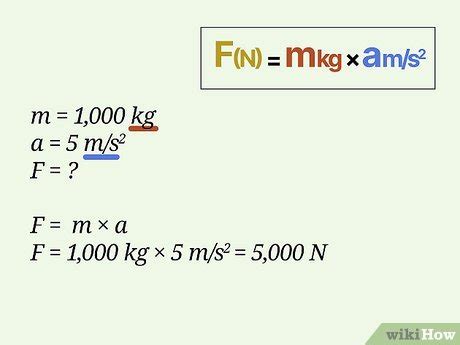
To understand the fundamental concept of force calculation, it is essential to grasp the basic principles and practical applications that govern this essential aspect of physics. Whether you’re an engineer evaluating a structure’s stability, a scientist conducting experiments, or simply curious about everyday phenomena, the ability to calculate force is indispensable. Here, we provide a focused professional guide to mastering the art of force calculation.
Understanding force calculation begins with a solid foundation in physics, particularly Newton’s Second Law of Motion. This law, F = ma (force equals mass times acceleration), is the cornerstone for calculating force in numerous applications. Through this article, we will delve into practical insights, evidence-based statements, and real-world examples to ensure a comprehensive understanding.
Key Insights
- Newton's Second Law forms the foundation for calculating force: F = ma.
- Practical applications include determining forces in mechanical engineering and structural integrity.
- To effectively calculate force, one must accurately determine mass and acceleration in the given context.
Principles of Force Calculation
Force calculation is grounded in Newton’s laws of motion, most specifically the second law, which provides a direct method for calculating force. The formula, F = ma, emphasizes that force is a product of an object’s mass and the acceleration it undergoes. This relationship is universally applicable, from the gravitational pull between celestial bodies to the force exerted by a car’s engine during acceleration. It’s vital to understand that acceleration is not just speed change; it includes any change in the velocity vector, whether it’s magnitude or direction.To demonstrate, consider a car accelerating uniformly. If the car’s mass is 1,500 kg and it undergoes an acceleration of 2 m/s², the force exerted can be calculated directly by substituting these values into the formula: F = 1,500 kg × 2 m/s², yielding a force of 3,000 N. This calculation reveals the necessary force to achieve the desired acceleration, crucial for engineers designing automotive systems.
Applications in Engineering and Physics
In practical engineering scenarios, force calculations are pivotal. For instance, in mechanical engineering, calculating the force exerted on various components of a structure under different load conditions ensures safety and integrity. Let’s consider a suspension bridge. Engineers must determine the forces at different points to ensure the bridge can handle vehicular and environmental loads without structural failure.Another example is the application of force calculation in biomechanics. Here, understanding how muscles generate force is crucial for designing prosthetics and understanding human movement. For instance, to calculate the force exerted by a muscle, one needs to consider the muscle’s mass, its physiological cross-sectional area, and the associated acceleration of the body part it moves.
What units are used in force calculation?
Force is measured in Newtons (N), where 1 N equals 1 kg·m/s². Mass is measured in kilograms (kg), and acceleration in meters per second squared (m/s²).
Can force calculation account for friction?
Yes, in real-world scenarios, friction often needs to be factored into force calculations. The force of friction can be calculated using the formula F_friction = μN, where μ is the coefficient of friction and N is the normal force acting perpendicular to the surface.
By mastering these principles and methods of force calculation, professionals in various fields can ensure accurate and safe designs, leading to innovative solutions and better understanding of physical phenomena. Each calculation starts with clear, precise measurements and adheres to Newton’s foundational laws, ensuring that every derived value contributes to a broader understanding of motion and stability.