Finding Horizontal Asymptotes: Quick, Expert Guide
Understanding how to find horizontal asymptotes is essential in calculus, particularly when analyzing the behavior of functions as they extend towards infinity. Horizontal asymptotes tell us how functions behave in the long run, either increasing or decreasing indefinitely. They offer valuable insights into a function’s end behavior and help in understanding limits. This guide will walk you through the practical steps to find horizontal asymptotes with actionable advice, real-world examples, and practical solutions, making it easier for you to grasp this concept.
If you're ever unsure how a function behaves as x approaches positive or negative infinity, this guide will help you identify horizontal asymptotes with confidence. This guide aims to address your needs by providing clear, step-by-step guidance on finding these asymptotic lines, ensuring you understand not just the 'what' but also the 'why' behind each step.
Quick Reference
Quick Reference
- Immediate action item: Compare the degrees of the numerator and denominator of a rational function
- Essential tip: If the degree of the numerator is less than the degree of the denominator, y = 0 is the horizontal asymptote.
- Common mistake to avoid: Forgetting to consider the leading coefficients when the degrees of numerator and denominator are equal.
Step-by-Step Guide to Finding Horizontal Asymptotes
Let's dive into the process of finding horizontal asymptotes for rational functions. This section will cover the foundational concepts and practical steps you need to master this skill.
1. Understanding Rational Functions
A rational function is defined as the ratio of two polynomials. The general form looks like this:
f(x) = P(x)/Q(x), where both P(x) and Q(x) are polynomials.
The behavior of this function, particularly its horizontal asymptote, depends on the degrees of these polynomials.
2. Degrees of Polynomials
The degree of a polynomial is the highest power of x in the polynomial. For instance:
- For P(x) = 3x^4 + 2x^2 - x + 5, the degree is 4.
- For Q(x) = x^3 - 7x + 9, the degree is 3.
The relationship between these degrees is key to finding horizontal asymptotes.
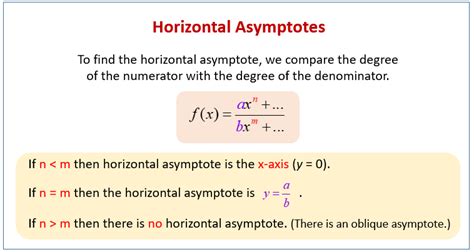
3. Rules for Finding Horizontal Asymptotes
Here are three primary rules to determine the horizontal asymptote of a rational function:
- If the degree of the numerator is less than the degree of the denominator, the horizontal asymptote is y = 0.
Example:
f(x) = 1/(x^2 + 1) has a horizontal asymptote at y = 0, because the degree of the numerator (0) is less than the degree of the denominator (2).
- If the degrees of the numerator and the denominator are equal, the horizontal asymptote is y = (leading coefficient of the numerator)/(leading coefficient of the denominator).
Example:
f(x) = 4x^3/(2x^3) has a horizontal asymptote at y = 4⁄2 = 2.
- If the degree of the numerator is greater than the degree of the denominator, there is no horizontal asymptote (the function will tend towards positive or negative infinity).
Example:
f(x) = x^4/(x^2 + 1) does not have a horizontal asymptote because the degree of the numerator (4) is greater than the degree of the denominator (2).
Practical Examples
To solidify your understanding, let’s explore some practical examples, complete with detailed solutions.
Example 1: f(x) = (3x^2 + 4)/(x^2 + 1)
In this function:
- Degree of numerator: 2
- Degree of denominator: 2
Since the degrees are equal, the horizontal asymptote is y = 3⁄1 = 3.
Example 2: f(x) = (2x)/(x^3 + 4)
Here:
- Degree of numerator: 1
- Degree of denominator: 3
Since the degree of the numerator is less than the degree of the denominator, the horizontal asymptote is y = 0.
Example 3: f(x) = (x^4 + 2)/(x + 1)
In this case:
- Degree of numerator: 4
- Degree of denominator: 1
The degree of the numerator is greater than the degree of the denominator, so there is no horizontal asymptote.
Practical FAQ
What if the leading coefficients are not 1?
If you encounter a rational function where the leading coefficients are not 1, just use these coefficients when determining the horizontal asymptote. For example, if you have f(x) = (5x^2)/(3x^2), the horizontal asymptote is y = 5⁄3, not 1⁄1.
Can there be more than one horizontal asymptote?
No, a rational function can only have one horizontal asymptote. However, it’s possible that as x approaches positive or negative infinity, the function approaches different values, creating the illusion of multiple horizontal asymptotes, but mathematically, only one holds.
How do I find horizontal asymptotes for complex rational functions?
Break the function down into simpler parts, and then apply the same rules. Simplify the rational function if possible before applying the degree comparison method. For example, for f(x) = (2x^2 + 3x + 1)/(x^2 - 4), compare the degrees 2 and 2, so the horizontal asymptote is y = 2⁄1 = 2.
This guide aims to demystify the process of finding horizontal asymptotes by providing step-by-step instructions, practical examples, and common FAQs. By following this guide, you should feel more confident in determining the end behavior of rational functions.