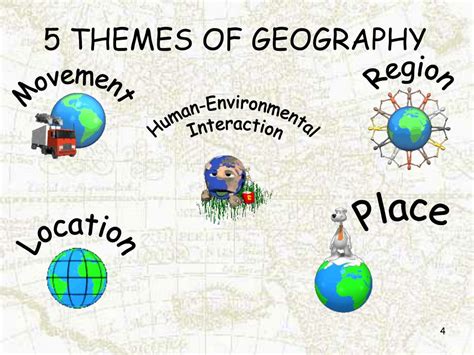
Geography stands as a pivotal academic discipline, intertwining the physical and human elements that shape our world. It is through geography that we explore and understand the spatial relationships that connect the Earth’s diverse phenomena. To fully grasp geography’s essence, one must delve into its five key themes. These themes serve as the cornerstone for interpreting the complexity of human-environment interactions. This article aims to demystify these themes with practical insights, backed by evidence and real-world examples.
Thematic Foundations: Location, Place, Human-Environment Interaction, Movement, and Region
Understanding geography requires familiarity with five foundational themes. These thematic lenses are indispensable in studying spatial patterns, dynamics, and processes shaping our world. Each theme carries unique significance and relevance.
Key Insights
- Location: The study of places in relation to one another, focusing on absolute and relative positioning.
- Human-Environment Interaction: Exploring how humans adapt to, modify, and depend on the environment.
- Actionable Recommendation: Use these themes to develop a robust comprehension of local and global spatial dynamics.
The Essence of Location
Location forms the first theme, offering the spatial context essential for understanding geographical phenomena. It differentiates between absolute and relative locations. Absolute location uses precise coordinates (latitude and longitude) for pinpoint accuracy, while relative location emphasizes the spatial relationships between places. For instance, analyzing the positioning of New York City not just by its coordinates (40.7128° N, 74.0060° W) but by its connectivity to major transport hubs, exemplifies relative location’s utility.
The Significance of Place
The concept of place encompasses both physical and human characteristics that make a location unique. It includes both tangible features like terrain, climate, and resources and intangible elements such as culture, traditions, and historical narratives. Consider the Golden Gate Bridge in San Francisco: its physical presence as an engineering marvel intertwines with its cultural symbolism as an iconic representation of the city, embodying the essence of place.
What role do these themes play in real-world applications?
These themes are crucial in urban planning, environmental management, and policy-making, aiding in strategic decision-making that considers spatial dimensions.
Human-Environment Interaction
This theme delves into how humans adapt to, modify, and depend on the environment. It examines the mutual relationships and impacts between people and their natural surroundings. A prominent example is the agricultural practice of terracing in hilly regions like the Philippines, where farmers create stepped fields on slopes to prevent soil erosion, combining human ingenuity with natural geography.
Movement: The Flow of People and Goods
Movement refers to the transfer of people, ideas, and goods across spaces. It includes migration, trade, and the spread of culture. The global trade of coffee from producer countries like Ethiopia to consumer countries such as the United States illustrates the dynamic movement theme. Understanding the movement of commodities not only highlights economic networks but also cultural exchanges that occur worldwide.
Regions: Spatial Organization of Similar Characteristics
Regions are areas defined by a set of similar characteristics, such as climate, culture, or economic activity. For instance, the European Union represents a political and economic region characterized by shared policies and integrated markets. Regions help in organizing geographical information, providing a framework for analysis and understanding spatial patterns.
How can educators effectively teach these themes?
Incorporate real-world case studies, interactive maps, and field trips to help students grasp abstract concepts through practical, experiential learning.
In conclusion, geography’s five themes offer invaluable frameworks for understanding our world. By dissecting location, place, human-environment interaction, movement, and region, we uncover the intricate web of spatial relationships that define our planet. Embracing these themes equips us with a powerful lens to navigate and interpret the complexities of human-environment interactions in both local and global contexts.