Understanding the electric potential equation can seem daunting at first, but with a clear and step-by-step approach, it becomes manageable and even fascinating. This guide will help demystify the concept, providing actionable advice and practical examples that you can implement immediately. Let’s get started and simplify this complex topic, making it accessible and useful for everyone.
Problem-Solution Opening Addressing User Needs
Imagine trying to understand how to navigate a new city without a map, or trying to solve a complex math problem without understanding the basic principles. In the world of physics, the electric potential equation can often feel just as overwhelming. Many beginners find themselves stuck, unsure of how to approach this fundamental concept in electromagnetism. This guide aims to break down the electric potential equation into digestible parts, giving you not only the knowledge but also practical tools to apply it in real-world scenarios. With our step-by-step guidance, you’ll gain the confidence to tackle electric potential with ease.
Quick Reference
Quick Reference
- Immediate action item: Start by identifying the charge source in a given electric field.
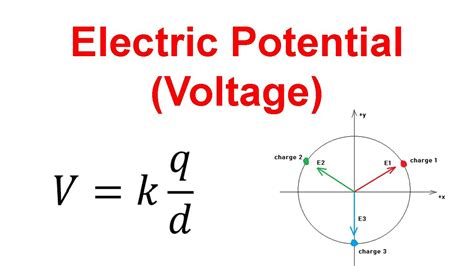
- Essential tip: Use the formula V = k * Q/r to calculate the electric potential due to a point charge, where k is Coulomb’s constant, Q is the charge, and r is the distance from the charge.
- Common mistake to avoid: Confusing electric potential with electric field strength; remember, potential is scalar while field strength is vector.
Understanding Electric Potential: A Detailed How-To
To begin with electric potential, let’s first define it. Electric potential at a point in an electric field is the work done in bringing a unit positive charge from infinity to that point. It is typically measured in volts (V). The equation for electric potential (V) due to a point charge (Q) is:
V = k * Q / r
Where:
- V is the electric potential (in volts, V).
- k is Coulomb’s constant (approximately 8.99 × 10⁹ N·m2/C2).
- Q is the charge creating the field (in coulombs, C).
- r is the distance from the charge to the point where you want to find the electric potential (in meters, m).
To calculate the electric potential, follow these steps:
- Identify the charge source: Determine the charge (Q) creating the electric field.
- Find the distance: Measure the distance (r) from the charge to the point where you are calculating the potential.
- Apply the formula: Plug the values into the formula V = k * Q / r.
For example, suppose you have a charge of 5 μC (micro-coulombs) located 2 meters away from a point in space. To find the electric potential at this point, you can follow these steps:
- Convert 5 μC to coulombs: 5 μC = 5 × 10⁻⁶ C.
- Use Coulomb's constant: k = 8.99 × 10⁹ N·m2/C2.
- Plug in the values: V = 8.99 × 10⁹ N·m2/C2 * 5 × 10-6 C / 2 m.
- Calculate the result: V = 22.475 × 10³ V or 22.475 kV.
Thus, the electric potential at that point is 22.475 kV.
Practical Application: Combining Multiple Charges
Real-world scenarios often involve multiple charges. When you have several point charges, you calculate the total electric potential by summing the potentials due to each charge individually. Here’s how:
For charges Q1, Q2, Q3,..., Qn located at distances r1, r2, r3,..., rn respectively, the total electric potential Vtotal is given by:
Vtotal = V1 + V2 + V3 +... + Vn
Where Vi = k * Qi / ri.
Here’s a step-by-step guide to applying this:
- List all charges: Identify and list all point charges present in the system.
- Calculate individual potentials: For each charge, calculate the potential Vi = k * Qi / ri.
- Sum the potentials: Add the individual potentials to get the total potential Vtotal.
For example, consider three charges of 2 μC, 4 μC, and 6 μC located 1 m, 2 m, and 3 m respectively from a point. To find the total potential:
- Convert the charges to coulombs: 2 μC = 2 × 10⁻⁶ C, 4 μC = 4 × 10⁻⁶ C, 6 μC = 6 × 10⁻⁶ C.
- Calculate individual potentials:
- For Q1 = 2 × 10⁻⁶ C at r1 = 1 m: V1 = (8.99 × 10⁹ N·m2/C2) * (2 × 10-6 C) / (1 m) = 17.98 × 10³ V or 17.98 kV.
- For Q2 = 4 × 10⁻⁶ C at r2 = 2 m: V2 = (8.99 × 10⁹ N·m2/C2) * (4 × 10-6 C) / (2 m) = 17.98 × 10³ V or 17.98 kV.
- For Q3 = 6 × 10⁻⁶ C at r3 = 3 m: V3 = (8.99 × 10⁹ N·m2/C2) * (6 × 10-6 C) / (3 m) = 17.98 × 10³ V or 17.98 kV.
- Sum the individual potentials: Vtotal = 17.98 kV + 17.98 kV + 17.98 kV = 53.94