Doppler Shift Equation Unveiled: Real Insights
Are you curious about how sounds and signals change when they move relative to their observers? Whether you’re dealing with police sirens that sound different as they approach or recede, or understanding how satellite communications work, the Doppler shift equation offers critical insights. This guide will walk you through not just the theoretical side but also practical applications and problem-solving tactics to make sense of these phenomena in everyday life.
Understanding the Doppler Shift Equation
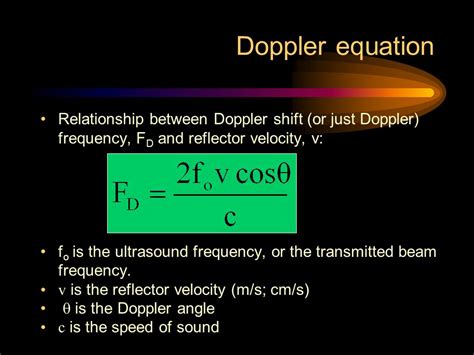
The Doppler Shift equation is an essential concept in physics that describes how the frequency of a wave changes when the source or the observer is moving. Specifically, it pertains to the change in frequency that we perceive based on the relative motion of the source and the observer.
The formula for the Doppler shift in the context of sound waves is given by:
f’ = f * (v + vo) / (v - vs)
where:
f’ is the observed frequency,
f is the original frequency of the wave,
v is the velocity of the wave in the medium (e.g., speed of sound in air), and
vo and vs are the velocities of the observer and the source, respectively. The signs depend on whether the source and observer are approaching or moving away from each other.
Quick Reference
Quick Reference
- Immediate action item: Measure the original frequency (f) and observe the relative velocities of the source (vs) and observer (vo) to calculate the observed frequency (f’).
- Essential tip: Use this equation for understanding radar speed measurements and emergency vehicle sirens.
- Common mistake to avoid: Confusing the directions of approach versus recession; ensure the correct sign is applied to vo and vs.
Practical Application: Using the Doppler Shift Equation in Emergency Services
Emergency services frequently use the Doppler shift equation to measure the speed of moving vehicles. Radar guns used by police officers are a prime example. Let’s dive into a detailed, step-by-step process to understand this:
Step-by-Step Process
1. Determine the frequency of the radar wave:
The police radar gun emits a microwave signal with a known frequency (f). For example, let's say f is 24.125 GHz.
2. Identify the velocity of the wave:
The speed of microwaves in the air is approximately 3 x 10^8 meters per second (the speed of light in a vacuum).
3. Measure the observed frequency:
As the vehicle moves, the frequency of the reflected wave changes and this new frequency (f’) is detected by the radar gun. Suppose the radar gun measures f’ = 24.128 GHz.
4. Determine the velocities:
To solve the Doppler shift equation, you need to know the velocity of the vehicle (vs). If you observe that the vehicle is moving towards the radar at a speed of 50 km/h, convert this into meters per second: 50 km/h = 13.89 m/s.
5. Calculate the observed frequency using the Doppler shift formula:
Insert the values into the equation:
f’ = f * (v + vo) / (v - vs)
f’ = 24.128 GHz * (3 x 10^8 + 0) / (3 x 10^8 - 13.89)
f’ = 24.128 GHz * (3 x 10^8) / (2.99861 x 10^8)
f’ = 24.128 GHz * 1.0017
f’ = 24.158 GHz (approximately)
From this, we can calculate the velocity of the vehicle and determine whether it’s speeding.
Advanced Applications: Satellite Communications
The Doppler shift principle is also vital in satellite communications, where satellites move relative to Earth-based receivers.
When calculating Doppler shifts for satellites, the frequency of the transmitted signal must be adjusted to account for the relative motion between the satellite and receiver. Here’s how you can apply the Doppler shift equation in this context:
Step-by-Step Process
1. Determine the transmitted frequency (f):
For example, a satellite transmits at a frequency of 1.5 GHz.
2. Identify the velocity of the wave:
Like with radar guns, we use the speed of light or microwave frequency in air, which remains constant at approximately 3 x 10^8 m/s.
3. Measure the observed frequency:
Suppose the satellite moves towards the receiver at 3,000 m/s, and the receiver detects an observed frequency (f’) of 1.502 GHz.
4. **Calculate the observed frequency using the Doppler shift formula:
Insert the values into the equation:
f’ = f * (v + vo) / (v - vs)
f’ = 1.5 GHz * (3 x 10^8 + 0) / (3 x 10^8 - 3,000)
f’ = 1.5 GHz * (3 x 10^8) / (2.997 x 10^8)
f’ = 1.5 GHz * 1.0007
f’ = 1.501 GHz (approximately)
This slight change in frequency helps adjust the transmission to maintain clear communication.
Practical FAQ
How do I account for both the source and observer moving?
When both the source and observer are moving, adjust the Doppler shift equation by including their velocities as positive values if moving towards each other and as negative values if moving away. For example, if the source moves towards the observer at 10 m/s and the observer towards the source at 5 m/s:
f’ = f * (v + vo + vs) / (v - vs + vo)
This way, you consider both movements to accurately determine the observed frequency.
Why is it important to keep units consistent?
Consistency in units is crucial because the Doppler shift equation relies on consistent values for velocity and frequency. Mixing units can lead to incorrect calculations and misinterpretations of the data. Always convert all velocities to meters per second and all frequencies to hertz (Hz).
Can the Doppler shift be applied to light waves?
Yes, the Doppler effect also applies to light waves, and it’s a critical concept in astrophysics for understanding the motion of celestial bodies. When dealing with light, instead of the speed of sound, use the speed of light (approximately 3 x 10^8 m/s) in your calculations.
Understanding and applying the Doppler shift equation can significantly help in fields ranging from police radar to satellite communication. By breaking down each component and following our practical steps, you’ll be equipped with the knowledge to solve real-world problems involving motion and frequency shifts.