Understanding the difference of cubes in algebra is pivotal for any student looking to build a strong foundation in mathematical concepts. This specific formula is often encountered in high school algebra and serves as a building block for more complex mathematical problems. Many students find this topic challenging, especially if they are unfamiliar with factoring or have not yet mastered the basics of polynomial identities. Our aim is to guide you through the concepts in a straightforward, user-focused manner, providing actionable advice to make the topic not only comprehensible but also manageable.
Understanding the Difference of Cubes
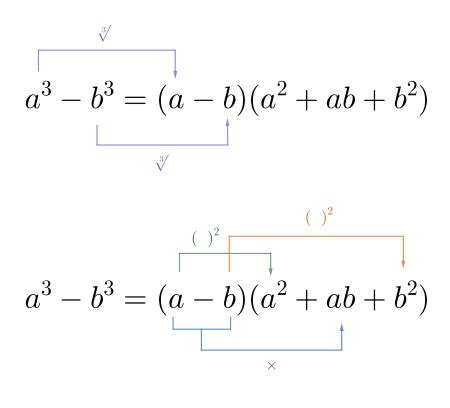
The difference of cubes formula helps you factor expressions of the form ( a^3 - b^3 ). At first glance, this might seem intimidating, but by breaking it down, you’ll find it’s much simpler than it appears. The formula is expressed as:
a^3 - b^3 = (a - b)(a^2 + ab + b^2)
This formula is incredibly useful for simplifying polynomial expressions and solving polynomial equations where such differences appear. Mastery of this formula not only helps you solve textbook problems but also strengthens your algebraic intuition, which is crucial for tackling more advanced math problems.
Quick Reference
Quick Reference
- Immediate action item: Practice with a few examples to understand the formula.
- Essential tip: To factor ( a^3 - b^3 ), apply the formula directly: ( (a - b)(a^2 + ab + b^2) )
- Common mistake to avoid: Forgetting to include the square and the middle term in the factor. It’s easy to miss the ( a^2 + ab + b^2 ) part.
Step-by-Step Guide to Factoring the Difference of Cubes
Let’s delve into a step-by-step approach to mastering the difference of cubes formula. This method is designed to gradually build your understanding, ensuring you don’t miss any crucial details along the way.
Step 1: Understand the Formula
To start, it’s crucial to understand what each part of the formula means. The expression ( a^3 - b^3 ) represents the difference between two cubes. The formula ( (a - b)(a^2 + ab + b^2) ) breaks down the original expression into a product of two binomials. Here, ( a ) and ( b ) represent any algebraic terms, which could be numbers or variables.
Step 2: Identify ( a ) and ( b )
When you encounter a difference of cubes, your first task is to identify the terms ( a ) and ( b ). Look for terms that are being cubed. For instance, in the expression ( x^3 - 8 ), ( x ) is ( a ) and ( 8 ) is ( b^3 ), where ( b ) is ( 2 ). This identification is critical because it dictates how you will apply the formula.
Step 3: Apply the Formula
Once you’ve identified ( a ) and ( b ), it’s time to apply the formula. Let’s take a concrete example: ( x^3 - 27 ). Here, ( x ) is ( a ) and ( 27 ) is ( b^3 ), so ( b ) is ( 3 ). Now we can factor this expression:
x^3 - 27 = (x - 3)(x^2 + 3x + 9)
Step 4: Verification
To ensure accuracy, you can expand the factored form to verify that it simplifies back to the original expression. Multiply ( (x - 3) ) and ( (x^2 + 3x + 9) ) using the distributive property:
(x - 3)(x^2 + 3x + 9) = x(x^2) + x(3x) + x(9) - 3(x^2) - 3(3x) - 3(9)
= x^3 + 3x^2 + 9x - 3x^2 - 9x - 27
= x^3 - 27
You see that the expanded form returns to the original x^3 - 27 . This step confirms the correctness of your factorization.
Step 5: Practice and Application
The best way to master this concept is through practice. Work on various examples, starting with simple ones like ( x^3 - 8 ) and gradually moving to more complex expressions involving variables. The more you practice, the more comfortable you will become with the formula.
Practical FAQ
Why is it important to understand the difference of cubes formula?
Understanding the difference of cubes formula is important because it provides a clear method for factoring expressions that initially appear complex. This skill not only simplifies polynomial expressions, making them easier to manipulate or solve but also builds a critical foundation for algebra. Mastery here helps in tackling higher-level math problems involving polynomials, calculus, and beyond.
What should I do if I encounter a complex difference of cubes problem?
Start by breaking the problem into manageable parts. Identify ( a ) and ( b ). Write down the formula and substitute accordingly. Take it step-by-step, first factoring the outer term, and then ensuring the quadratic part is correct. If you’re stuck, try practicing simpler problems to reinforce your understanding before tackling complex ones.
Are there any common pitfalls to avoid when using the difference of cubes formula?
Yes, a common pitfall is forgetting the ( a^2 + ab + b^2 ) part of the factorization. Always double-check to ensure you’ve included all terms. Also, make sure you’re correctly identifying ( a ) and ( b ). If you’re working with variables, ensure they’re correctly squared and multiplied. Double-check your factoring work by expanding the factors to verify they simplify to the original expression.
By understanding and applying the difference of cubes formula, you gain a valuable tool in your algebra toolkit. This guide provides a thorough step-by-step method, along with tips to avoid common mistakes, ensuring that you’re well-equipped to master this fundamental algebraic concept.