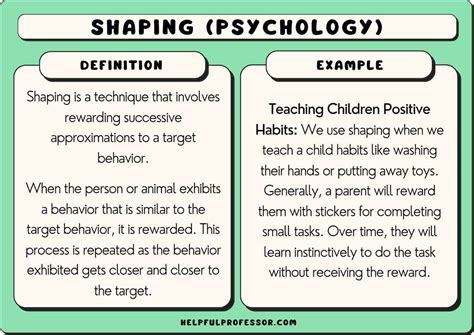
The practice of shaping in psychology is a powerful technique used to modify behavior through reinforcement. It’s a systematic approach that employs successive approximation, which incrementally guides behavior towards a desired goal. Understanding shaping is pivotal for both applied behavior analysis and everyday parenting or training scenarios. In this guide, we’ll delve into the nuances of shaping, offering practical insights and evidence-based strategies to master this technique.
Key Insights
- Shaping leverages reinforcement to gradually modify behavior.
- Technical precision in defining target behavior is essential for effective shaping.
- Implementing clear and immediate reinforcement enhances learning efficiency.
Understanding the Mechanics of Shaping
Shaping operates on the foundational principles of reinforcement, where specific behaviors are rewarded to gradually evolve them toward a target behavior. It’s not a one-size-fits-all approach but a customizable process tailored to the learner’s current abilities and desired outcomes. In the context of a child learning to tie their shoes, for instance, shaping would start by rewarding any movement that brings them closer to the final act of tying a knot, such as pulling the shoestrings over the tongue.
A quintessential example in professional settings is training service animals. Here, shaping would start with basic responses, such as looking at a handler, and gradually progress to more complex tasks, like retrieving objects or navigating obstacles. The reinforcement here could be anything from verbal praise to a tangible reward like a treat, depending on the animal’s responsiveness and the desired behavior’s complexity.
Techniques and Strategies for Effective Shaping
Effective shaping requires careful consideration of both the behavior to be shaped and the reinforcement strategy. The first step involves breaking down the target behavior into smaller, manageable steps. Each of these steps must be observable, measurable, and clearly distinguishable from one another. This segmentation allows for precise reinforcement at each stage, ensuring that the learner receives immediate feedback on their progress.
For instance, in a classroom setting, a teacher might use shaping to encourage students to complete their homework on time. Initially, the teacher could reward any student who makes an attempt to start the homework, even if they don’t complete it. Over time, the criteria for reinforcement can be adjusted to include completing sections of the assignment and eventually finishing the entire homework. Using a clear and consistent reinforcement schedule helps maintain engagement and accelerates learning.
How long does shaping take?
The duration of shaping varies depending on the complexity of the behavior and the individual learner's pace. Some behaviors might only take a few sessions to shape, while others may require several weeks or even months of consistent effort.
Can shaping be used with any age group?
Yes, shaping is versatile and can be applied across all age groups. It’s particularly effective in early childhood education and animal training, but it’s also beneficial for adults learning new skills or adapting to behavioral changes.
To wrap up, mastering shaping in psychology involves an in-depth understanding of reinforcement mechanisms and the strategic breakdown of behaviors into manageable steps. By employing precise, observable criteria and clear reinforcement, shaping can be a remarkably effective tool in various fields, from education to animal training. This technique’s success lies in its adaptability and the immediate, clear feedback it provides, making it an indispensable strategy for behavior modification.