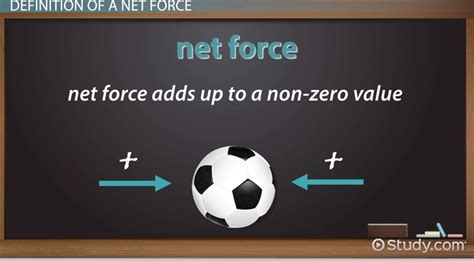
Defining net force is essential for understanding fundamental physics concepts and has practical implications across various scientific fields. In essence, net force is the combined effect of all forces acting upon an object. By mastering this concept, engineers can design safer vehicles, physicists can predict particle behavior, and educators can enhance comprehension among students. This article delves into the intricate yet fascinating world of net force, providing expert perspectives and actionable insights.
Key Insights
- Net force as the sum of all forces acting on an object, influencing its motion.
- Understanding the importance of vector addition in net force calculation.
- Implementing net force principles in real-world applications such as automotive safety.
Understanding Net Force and Its Calculation
Net force is fundamentally defined as the vector sum of all individual forces acting on an object. This concept forms the cornerstone of Newton’s second law, where the net force applied to an object is equal to the product of its mass and acceleration (F=ma). To calculate net force, it’s crucial to consider the direction and magnitude of each force involved. This often necessitates the use of vector addition, where forces are represented as arrows, and their resultant force is determined by adding these arrows geometrically.In practical applications, the net force can determine the motion of an object. For instance, in automotive safety engineering, understanding how different forces impact a vehicle during an accident can lead to the design of better safety features, such as airbags and seatbelts, which rely on the principles of net force.
The Role of Net Force in Motion and Behavior
The impact of net force on an object’s motion cannot be overstated. When the net force on an object is zero, it remains at rest or moves with a constant velocity due to inertia, according to Newton’s first law of motion. Conversely, a non-zero net force results in acceleration, directly proportional to the net force and inversely proportional to the object’s mass.Consider the motion of a spacecraft. When multiple forces, such as thrust from rockets and gravitational pull from celestial bodies, act upon it, the spacecraft’s path is determined by the net force. Engineers must meticulously calculate these forces to navigate the spacecraft accurately, emphasizing the critical role of net force in space travel and beyond.
What happens if the net force is zero?
If the net force acting on an object is zero, the object will not accelerate. It will either remain at rest or continue moving with constant velocity, based on its initial state, due to Newton’s first law of motion.
Can net force be negative?
Yes, net force can be negative, indicating that the resultant force acts in the opposite direction to the defined positive direction. A negative net force means that the forces are acting collectively in the opposite direction to the positive axis.
Delving into the principle of net force reveals its profound impact on both theoretical and practical realms of physics. It is the gateway to comprehending the dynamics governing the universe, from the microscopic world of particles to the macroscopic scale of celestial bodies. By applying this concept, we can unlock new frontiers in technology, engineering, and education, ultimately enhancing our understanding and control over the physical world.