Mastering the A Priori: Essential Definition
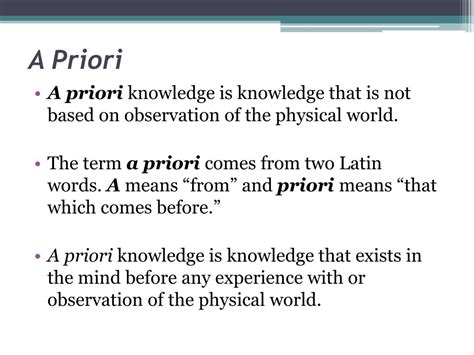
The concept of a priori knowledge has been a cornerstone in philosophical debates for centuries, offering significant implications for how we understand knowledge acquisition and validation. At its core, a priori knowledge refers to information or truths that are known or demonstrable by reason and independent of experience. In other words, a priori knowledge is the type of knowledge that can be validated through logical reasoning without reliance on empirical evidence. This can include mathematical truths, logical axioms, and certain metaphysical principles.
Key insights box:
Key Insights
- A priori knowledge is independent of empirical evidence, grounded purely in reason.
- Mathematical truths such as “2 + 2 = 4” exemplify a priori knowledge, demonstrable through logical deduction.
- Understanding a priori can enhance one’s comprehension of the foundational aspects of scientific and philosophical theories.
Delving into the nature of a priori knowledge, it is fundamentally categorized into two realms: synthetic a priori knowledge and analytic a priori knowledge. Synthetic a priori knowledge, often associated with Immanuel Kant, refers to statements that are necessarily true and provide new information beyond what is given in the premises. For example, Kant argued that space and time are synthetic a priori intuitions that structure our experiences. In contrast, analytic a priori knowledge involves truths that are logically necessary and do not extend our understanding beyond the given terms, such as “All bachelors are unmarried.”
The interplay between a priori and empirical knowledge is vital in the epistemological discussions. Many argue that empirical knowledge, or a posteriori knowledge, derived from experience, complements a priori reasoning by grounding abstract principles in real-world contexts. A quintessential example is the scientific method, which hinges on a priori logical frameworks to hypothesize and test empirical predictions. This amalgamation of a priori and a posteriori knowledge forms the bedrock of contemporary scientific inquiry.
Practical implications of understanding a priori knowledge are profound across various disciplines. In mathematics, a priori truths form the foundation upon which entire theories are built, allowing mathematicians to prove theorems and explore abstract relationships. For instance, the Pythagorean theorem is a prime example of a priori knowledge, as it is a logical necessity that can be deduced without any empirical validation. In natural sciences, the predictive power of a priori principles allows scientists to develop models and theories that can be tested empirically. The general theory of relativity is a case in point, where the a priori principles of space and time led to a framework that could be validated through astronomical observations.
FAQ section:
What is the difference between a priori and a posteriori knowledge?
A priori knowledge is independent of empirical evidence and derived purely from reason, such as mathematical truths. A posteriori knowledge, in contrast, is derived from experience and empirical evidence, providing insights based on observation and experimentation.
How does a priori knowledge contribute to scientific research?
A priori knowledge contributes to scientific research by providing the foundational logical frameworks and hypotheses that guide empirical investigation. It allows scientists to formulate theories that can be systematically tested and validated through experiments and observations.
The integration of a priori knowledge in philosophical and scientific paradigms is critical for developing coherent and robust intellectual frameworks. By understanding the distinction and interdependence of a priori and a posteriori knowledge, we can better appreciate the nuanced ways in which human cognition processes and validates information. This appreciation is essential for anyone seeking to master the intricate tapestry of human knowledge.