Understanding logical operations like converse, contrapositive, and inverse is fundamental in mathematics, logic, and everyday problem-solving. Often, learners find these concepts challenging due to their abstract nature. This guide is designed to break down these logical terms into understandable and practical elements that can easily fit into your learning and problem-solving toolkit.
Welcome to Logical Reasoning
Logical reasoning is essential in various fields, including mathematics, computer science, philosophy, and everyday decision-making. Mastering the concepts of converse, contrapositive, and inverse can significantly enhance your analytical skills. While these terms might initially seem daunting, this guide provides step-by-step guidance, actionable advice, and practical examples to ensure you grasp these concepts fully.
Before we dive into the intricate details, it’s essential to understand the significance of these concepts in problem-solving and critical thinking. They help us understand the relationships between different statements, which is crucial in forming valid arguments and proofs.
Problem-Solution Opening
When faced with logical statements, many learners struggle to differentiate between the converse, contrapositive, and inverse. These terms describe various transformations of a given conditional statement and are foundational for understanding logical implications. This guide aims to clarify these terms through practical examples and real-world applications, allowing you to easily apply these concepts in both academic and everyday situations.
Imagine you're analyzing a proof in a math textbook or evaluating an argument in a debate. Being able to recognize and manipulate these logical forms can make a significant difference in your comprehension and effectiveness. This guide will break down the essentials so that you can tackle any logical statement with confidence.
Quick Reference
Quick Reference
- Immediate action item: Identify the original conditional statement and its components. For example, in “If P, then Q,” P is the hypothesis and Q is the conclusion.
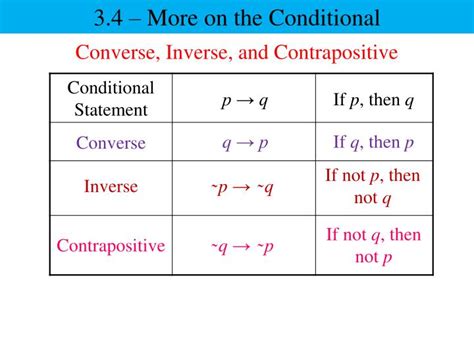
- Essential tip: To find the converse, switch P and Q: “If Q, then P.” To find the inverse, negate both P and Q: “If not P, then not Q.” To find the contrapositive, switch and negate both P and Q: “If not Q, then not P.”
- Common mistake to avoid: Confusing the converse with the contrapositive. Remember, the contrapositive always maintains the truth value of the original statement, while the converse does not.
Converse of a Conditional Statement
The converse of a conditional statement flips the hypothesis and conclusion of the original statement. For example, if your original statement is “If it rains, then the ground will be wet” (If P, then Q), the converse would be “If the ground is wet, then it rained” (If Q, then P).
Let's look at a practical example to understand the application better:
Original statement: If a number is divisible by 4, then it is even.
Converse: If a number is even, then it is divisible by 4.
Notice that the converse changes the hypothesis and conclusion but does not necessarily retain the truth value of the original statement. Many times, the converse of a true statement is false.
Step-by-Step Guide to Finding the Converse
- Identify the original statement: Write down the conditional statement clearly. For example, “If a number is divisible by 3, then it is divisible by 6.”
- Switch the hypothesis and conclusion: Swap the parts of the statement. In our example, it becomes “If a number is divisible by 6, then it is divisible by 3.”
- Check for validity: Evaluate whether the new statement logically follows. In the given example, it does not hold since not all numbers divisible by 6 are divisible by 3.
Contrapositive of a Conditional Statement
The contrapositive of a conditional statement negates and swaps the hypothesis and conclusion of the original statement. For example, if the original statement is “If P, then Q,” the contrapositive is “If not Q, then not P.”
Here's another practical example:
Original statement: If a student studies hard, then they will get good grades.
Contrapositive: If a student does not get good grades, then they did not study hard.
The contrapositive shares the same truth value as the original statement, making it a powerful tool in proofs and logical arguments.
Step-by-Step Guide to Finding the Contrapositive
- Identify the original statement: Write down the conditional statement clearly. For example, “If a triangle is equilateral, then it is equiangular.”
- Negate both parts: Change “is” to “is not.” In our example, it becomes “If a triangle is not equiangular, then it is not equilateral.”
- Swap the hypothesis and conclusion: The statement should now read “If a triangle is not equilateral, then it is not equiangular.”
Inverse of a Conditional Statement
The inverse of a conditional statement negates both the hypothesis and conclusion of the original statement. For example, if the original statement is “If P, then Q,” the inverse is “If not P, then not Q.”
Here's a real-world example:
Original statement: If an animal is a cat, then it is a mammal.
Inverse: If an animal is not a cat, then it is not a mammal.
The inverse does not necessarily share the same truth value as the original statement.
Step-by-Step Guide to Finding the Inverse
- Identify the original statement: Write down the conditional statement clearly. For example, “If a number is greater than 5, then it is positive.”
- Negate both parts: Change “greater than” to “not greater than” and “positive” to “not positive.” In our example, it becomes “If a number is not greater than 5, then it is not positive.”
- Check for validity: Evaluate whether the new statement logically follows. Here, the inverse is generally false since negative numbers can still be greater than 5.
Practical FAQ
How do I determine if a converse is true?
To determine if a converse is true, you need to evaluate if the reversed hypothesis and conclusion logically follow each other. In most cases, the converse of a true statement is not necessarily true. Use real-world examples to test: If the original statement “If it’s snowing, then the ground is wet” holds, its converse “If the ground is wet, then it’s snowing” does not logically follow because the ground can get wet by rain too.
Why is the contrapositive important?
The contrapositive is crucial because it maintains the truth value of the original statement. If the original statement is true, the contrapositive is also true, which makes it a reliable tool for proofs. For instance, if "If it rains, then the ground will be wet" holds, then its contrapositive "If the ground is not wet, then it did not rain" also holds true.
Can the inverse ever be true?
The inverse of a statement can sometimes be true, but it does not reliably follow from the truth of the original statement. You need to verify each case individually. For example, "If a number is an even integer, then it is divisible by 2." Its inverse "If a number is not divisible by 2, then it is not an even integer" is true because if a number is not even, it must be odd, which cannot be divisible by 2.
By understanding and practicing these logical operations, you’ll be better equipped to tackle complex problems and arguments across various fields. These skills are not only useful academically but also in everyday reasoning and decision-making