Mastering ‘Conjugate the Verb Ser’: Quick Guide
Learning Spanish can be an enriching journey, especially when one starts to unravel the subtleties of its grammar. One essential element of mastering Spanish is understanding how to conjugate verbs correctly. Among these, the verb’ser’ stands out due to its unique nature and frequent usage. ‘Ser’ is an irregular verb that means ‘to be’ and is foundational in Spanish grammar. This guide aims to provide practical insights into mastering the conjugation of’ser’, making it a part of your everyday communication.
Key Insights
- Understanding when to use'ser' over 'estar' is critical for grammatical accuracy.
- The conjugation of'ser' changes according to tense and subject, which requires careful practice.
- Reinforce your learning through real-life usage in sentences and dialogues.
Why 'Ser' Matters in Spanish
‘Ser’ is more than just a verb; it’s a verb that describes inherent qualities. Unlike ‘estar’, which denotes temporary states or conditions,‘ser’ is used to express fixed attributes. This distinction is pivotal. For instance, saying ‘Soy médico’ means ‘I am a doctor’ (a profession), whereas ‘Estoy cansado’ means ‘I am tired’ (a temporary state). Mastering’ser’ allows you to convey deeper and more permanent aspects of identity and existence in Spanish.
Conjugating 'Ser' Across Different Tenses
Conjugating’ser’ across various tenses requires understanding its unique irregular forms. Here’s a quick overview:
Present Tense
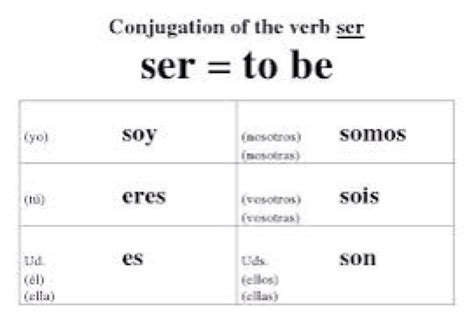
Here’s the primary conjugation form of’ser’ in the present tense:
- Yo soy
- Tú eres
- Él/Ella/Usted es
- Nosotros somos
- Vosotros sois
- Ellos/Ellas/Ustedes son
Preterite Tense
In the past,‘ser’ changes as follows:
- Yo fui
- Tú fuiste
- Él/Ella/Usted fue
- Nosotros fuimos
- Vosotros fuisteis
- Ellos/Ellas/Ustedes fueron
The preterite tense often refers to completed actions in the past, which are important for narrative contexts.
Practical Usage and Application
To cement your understanding, it’s crucial to practice the conjugation of’ser’ in various contexts. Use it in sentences that reflect permanent states or characteristics. For instance:
“Este libro es interesante.” (This book is interesting.) “Ella es mi mejor amiga.” (She is my best friend.)
Integrate ‘ser’ into dialogues to simulate real-life scenarios. For example:
- Person A: ¿Cómo eres?
- Person B: Soy optimista y trabajador.
- Person A: ¿Cuál es tu trabajo?
- Person B: Soy ingeniero.
By engaging in these activities, the conjugation of’ser’ becomes more than rote memorization; it transforms into a natural part of your Spanish language repertoire.
Is'ser' used only for identity?
No,'ser' is used for much more than just identity. It also describes origins, characteristics, and time. Remember,'ser' is foundational for indicating what someone or something is fundamentally.
By incorporating these insights, technical understandings, and practical examples, mastering the verb’ser’ becomes not just a grammatical task but a vital part of your linguistic toolkit.