The journey to understanding the Bible’s canon formation is both intricate and essential for grasping the foundation of Christian faith. The process behind selecting which books constitute the holy texts has been a topic of scholarly interest and theological debate for centuries. This article delves into the critical elements that shaped the canon, offering expert perspectives and real examples to unravel this mystery.
Key Insights
- The primary insight is that the formation of the Bible canon involved a complex interplay between early Christian communities and Jewish traditions.
- A technical consideration lies in understanding the role of authority and consensus in determining which texts were included.
- An actionable recommendation is to study the historical and theological contexts that influenced the canon decisions.
Historical Context and Early Christian Developments
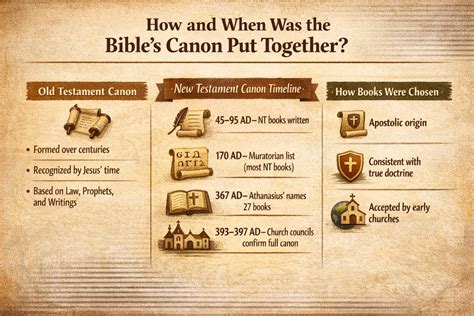
The canon of the Bible is a compilation of texts that were deemed authoritative by early Christian communities. During the first few centuries AD, Christians began to look beyond their Jewish heritage and developed their own scriptural traditions. The early Christian community’s need for authoritative texts that encapsulated their faith led to the formalization process. This was largely influenced by the Jewish Scriptures, known as the Tanakh, which provided a foundational reference point.
The writings of church fathers like Irenaeus and Clement of Alexandria provide critical insights into this period. They referenced texts that would later form the New Testament, establishing a precedent for authority that shaped the canon. The need to distinguish between inspired and non-inspired writings was paramount, marking the beginning of the canon formation process.
Criteria for Canonization
Establishing a canon required more than simply gathering texts; it involved setting criteria that the texts had to meet to be deemed authoritative. Scholars agree that key criteria included apostolic origin, consistency with Jewish Scriptures, and universal acceptance among early Christian communities. For instance, the Epistles of Paul, written by an early Christian leader with direct ties to Jesus, were highly regarded. Texts needed to demonstrate a continuity of doctrine and practice with the teachings of Jesus and the apostles.
A practical example of this can be seen in the way the Gospel of John was embraced by early Christians. Unlike the Synoptic Gospels (Matthew, Mark, and Luke), John’s Gospel offered a theological depth that appealed to a broader Christian audience, thus aiding its canonization. This highlights how doctrinal significance and reception played a crucial role in the process.
Why were certain books excluded from the Bible?
Books that did not meet the criteria of apostolic origin, consistency with Jewish and Christian teachings, and universal acceptance were often excluded. Examples include the apocryphal texts that while valuable, lacked the universal acceptance or the perceived divine authority of the canonical books.
What role did church councils play in canon formation?
Church councils, especially the Council of Trent in the 16th century, played a formal role in canon confirmation, validating the lists that had been evolving over centuries. Earlier councils such as those in Hippo and Carthage helped solidify consensus on the New Testament books.
The formation of the Bible’s canon was an essential development in the history of Christianity, reflecting the early church’s efforts to define its theological and doctrinal identity. By understanding the criteria and historical context behind the canonization process, one gains a deeper appreciation of the Bible’s authority and significance in the faith of millions.