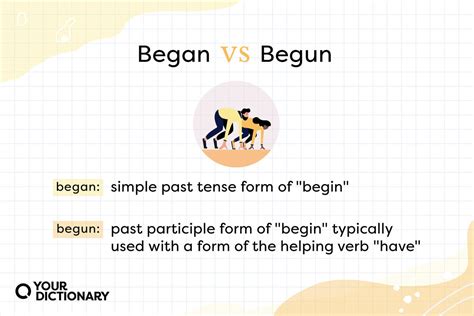
The distinction between “began” and “begun” can often cause confusion in English writing. Mastering these two forms of the verb “to begin” is crucial for precise communication and professional writing. While “began” serves as the simple past tense, “begun” is the past participle, usually requiring a helping verb to form the perfect tenses. Understanding how and when to use each can elevate the quality of your writing, ensuring clarity and correctness.
Key Insights
- Use began for the simple past tense when no auxiliary verbs are needed.
- Employ begun in past perfect or perfect tenses, where a helping verb is required.
- Be mindful of context to avoid incorrect usage, ensuring grammatical accuracy.
To delve deeper into the practical applications, it is essential to understand the difference in context in which each form is used. Began signifies an action that occurred at a specific point in the past, without any need for additional tense markers. For example, in the sentence “The meeting began at noon,” the past action is straightforward and doesn’t require a perfect construction. In contrast, begun integrates with a helping verb to indicate that an action started in the past and either continues up to the present or is completed with relevance to another past event.
When to Use “Began”
As the simple past tense, began should be used when narrating a sequence of past events or stating when an action happened. For instance, in the sentence “She began her journey in the morning,” “began” denotes a singular, completed action in the past. It is straightforward and doesn’t require the complexity of additional verbs.
When to Use “Begun”
The past participle begun must always accompany a helping verb to form perfect tenses. This is pivotal in indicating that an action was initiated and either continued up to a certain time in the past or is relevant to another action. Consider the sentence “By the time they arrived, the show had begun.” Here, had begun connects two events in the past, showing the sequence and relevance of actions. Another example includes the present perfect tense: “They have begun the project,” indicating that the project’s initiation has relevance to the present.
Can "began" and "begun" be used interchangeably?
No, they cannot be used interchangeably. Began is the simple past tense and is used alone to describe a past event. Begun is the past participle and always needs a helping verb to form perfect tenses.
What is an example of using "begun" in a sentence?
An example of begun in a sentence is: "The construction of the new building has begun, and it is expected to be completed by next year." Here, "has begun" clearly shows an action that started in the past and continues to have present relevance.
In conclusion, while the difference between “began” and “begun” may seem trivial at first glance, it plays a critical role in conveying precise timing and relevance in writing. By understanding and applying these rules, writers can ensure their work is not only grammatically correct but also clear and professional. Remember to use “began” for the simple past and “begun” with a helping verb to express perfect tenses for the most effective communication.