Understanding and mastering the use of preterite endings in Spanish is crucial for achieving fluency and accurately conveying past actions. This guide will provide a clear, actionable roadmap, addressing the common pain points users face, with real-world examples and practical solutions.
Let’s start with a fundamental issue many learners grapple with: the confusion between different forms of preterite endings. The preterite tense is used to describe completed actions in the past. It differs significantly from the imperfect tense, which describes ongoing or habitual actions. The preterite form of regular verbs ends in specific patterns depending on the subject pronoun.
Quick Reference
Quick Reference
- Immediate action item: Begin practicing with regular verbs and focus on the three main groups in the preterite tense: -ar, -er/-ir. Use flashcards to reinforce your learning.
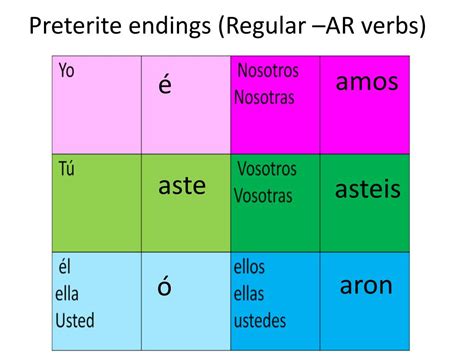
- Essential tip: To conjugate regular verbs in the preterite tense, drop the infinitive ending and add the corresponding preterite ending. For -ar verbs, add -é, -aste, -ó, -amos, -asteis, -aron. For -er/-ir verbs, add -í, -iste, -ió, -imos, -isteis, -ieron.
- Common mistake to avoid: Misusing the stem in irregular verbs. For instance, “yo comí” (I ate) and “yo dormí” (I slept) uses the correct preterite endings but remember that the stems change for some verbs like ‘ir’ and’ser’.
How to Master Regular -ar Verbs in the Preterite Tense
To get a solid grasp of the preterite endings for -ar verbs, let’s break it down step-by-step:
1. Identify the infinitive form:
First, identify the verb in its infinitive form. For example, “hablar” (to talk) is an -ar verb.
2. Drop the -ar ending:
Next, drop the -ar ending to get the verb stem. In our example, “hablar” becomes “habl-.”
3. Add the correct preterite ending:
Finally, add the appropriate preterite ending based on the subject pronoun:
- Yo hablo → yo hablé
- Tú hablas → tú hablaste
- Él/Ella/Ud. habla → él/ella/usted habló
- Nosotros hablamos → nosotros hablamos
- Vosotros habláis → vosotros hablasteis
- Ellos/Ellas/Uds. hablan → ellos/ellas/ustedes hablaron
Examples with sentences:
Yo hablé con mi amigo ayer. (I talked with my friend yesterday.)
Tú cantaste muy bien en la fiesta. (You sang very well at the party.)
Nosotros viajamos a España el verano pasado. (We traveled to Spain last summer.)
How to Master Regular -er and -ir Verbs in the Preterite Tense
The preterite endings for -er and -ir verbs are similar but with some differences:
1. Identify the infinitive form:
Start by identifying the verb in its infinitive form. For example, “comer” (to eat) is an -er verb and “vivir” (to live) is an -ir verb.
2. Drop the infinitive ending:
Remove the -er or -ir ending to get the verb stem:
- comer → com-
- vivir → viv-
3. Add the correct preterite ending:
Now add the appropriate preterite ending based on the subject pronoun:
- Yo como → yo comí
- Tú comes → tú comiste
- Él/Ella/Ud. come → él/ella/usted comió
- Nosotros comemos → nosotros comimos
- Vosotros coméis → vosotros comisteis
- Ellos/Ellas/Uds. comen → ellos/ellas/ustedes comieron
- Yo vivo → yo viví
- Tú vives → tú viviste
- Él/Ella/Ud. vive → él/ella/usted vivió
- Nosotros vivimos → nosotros vivimos
- Vosotros vivís → vosotros vivisteis
- Ellos/Ellas/Uds. viven → ellos/ellas/ustedes vivieron
Examples with sentences:
Ella comió una deliciosa cena anoche. (She ate a delicious dinner last night.)
Nosotros vivimos en una bonita casa. (We lived in a nice house.)
Ellos estudiaron en la biblioteca toda la tarde. (They studied at the library all afternoon.)
Practical FAQ
Why do some verbs have irregular preterite endings?
Certain verbs have irregularities in the preterite tense to maintain their original sounds or meanings. For example:
- Ser (to be) changes entirely: yo fui, tú fuiste, él/ella/usted fue, nosotros fuimos, vosotros fuisteis, ellos/ellas/ustedes fueron.
- Ir (to go) changes the stem to ‘fu-’: yo fui, tú fuiste, él/ella/usted fue, nosotros fuimos, vosotros fuisteis, ellos/ellas/ustedes fueron.
- Haber (to have) changes the stem: yo hube, tú hubiste, él/ella/usted hubo, nosotros hubimos, vosotros hubisteis, ellos/ellas/ustedes hubieron.
Study these irregular verbs separately and practice them until they become second nature.
By mastering these basic structures and practicing regularly, you will find that conveying past actions in Spanish becomes second nature. Regular practice, especially through writing and speaking, will enhance your fluency and confidence.
Conclusion
Understanding and applying preterite endings is fundamental to expressing past actions in Spanish. By following this guide with its clear step-by-step instructions, practical examples, and tips, you will master this tense effectively. Remember to practice with real-life sentences, use flashcards, and immerse yourself in Spanish-speaking environments to solidify your learning. Happy studying!