In the grand theater of evolution, the emergence of new species is often as mesmerizing as it is intricate. Among the myriad mechanisms behind this process, allopatric and sympatric speciation stand out for their distinct approaches to divergence. Understanding these processes is crucial for biologists and evolutionary scientists who seek to unravel the secrets of biodiversity and the factors driving species formation.
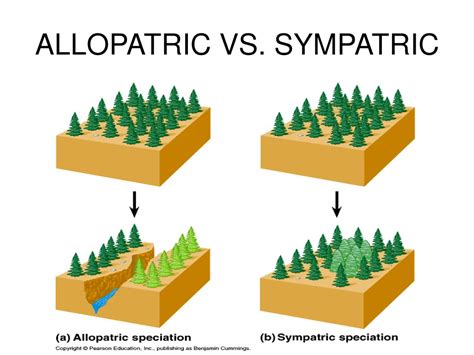
In allopatric speciation, geographical barriers play a critical role in separating populations, leading to the eventual emergence of new species. Imagine a group of birds that finds themselves isolated on different islands due to rising sea levels. Over time, genetic mutations, natural selection, and the constraints imposed by each island’s environment cause these populations to diverge. Eventually, they evolve into distinct species, no longer interbreeding despite the possibility of reuniting. This process is evident in the Galápagos finches, whose isolation drove divergent evolutionary paths.
Conversely, sympatric speciation occurs without geographical separation, primarily driven by ecological or behavioral mechanisms. Here, populations can remain in the same geographical area while evolving differences that lead to reproductive isolation. A classic example is the cichlid fish in African lakes. Through ecological niches, aggressive behavior, or even differences in mating signals, these fish populations can evolve into distinct species while coexisting in the same lake.
Key insights box:
Key Insights
- Allopatric speciation is largely driven by geographical isolation, whereas sympatric speciation is driven by ecological or behavioral factors.
- Geographical barriers in allopatric speciation can lead to genetic drift and natural selection over time, while sympatric speciation often involves niche partitioning.
- Understanding these processes helps predict and manage biodiversity in changing environments.
In this article, we will delve deeper into the nuances of both processes, providing evidence-based insights and real-world examples to highlight the complex yet fascinating pathways of speciation.
Two primary types of speciation, allopatric and sympatric, serve as windows into the evolutionary dynamics shaping the natural world.
Allopatric speciation operates through a process of geographic separation. When a population is divided by a physical barrier—such as a mountain range, desert, or ocean—genetic divergence becomes inevitable. Over time, these isolated populations are subjected to different environmental pressures, leading to adaptations unique to their specific habitat. This divergence is often accelerated by genetic drift, a random change in allele frequencies, which can be more pronounced in small, isolated populations. As a result, what begins as minor genetic differences can culminate in the formation of new species. The classic example of allopatric speciation is the process that formed the diverse groups of organisms found on the various islands of the Galápagos Archipelago.
In contrast, sympatric speciation involves the emergence of new species within the same geographic area. Here, without physical barriers, ecological and behavioral adaptations lead to reproductive isolation. This form of speciation is driven by niche differentiation or sexual selection mechanisms. Ecological niche differentiation can occur when populations partition resources or habitats, leading to distinct adaptations. For instance, different types of cichlid fish in Lake Malawi have evolved to occupy different niches, such as specializing in feeding on particular types of food, thus reducing competition and driving speciation.
Analysis of these two speciation processes reveals not only their differing mechanisms but also their profound implications for evolutionary biology. Allopatric speciation highlights the role of geography in shaping species diversity, while sympatric speciation underscores the power of ecological and behavioral adaptations in creating new species. Both processes underscore the dynamic and intricate nature of evolution.
FAQ section:
Is allopatric speciation more common than sympatric speciation?
Allopatric speciation is often cited as more common because geographical barriers are a more straightforward and frequently occurring phenomenon. However, sympatric speciation is also prevalent, particularly in environments where ecological or behavioral mechanisms can lead to rapid divergence.
Can sympatric speciation happen without any barriers?
Yes, sympatric speciation occurs without physical barriers. Instead, it relies on ecological or behavioral adaptations that create reproductive isolation within a shared environment.
Understanding allopatric versus sympatric speciation equips scientists with the knowledge to better predict and manage biodiversity in an ever-changing world. By examining real-world examples and evidence-based studies, we gain invaluable insights into the evolutionary processes that have shaped, and will continue to shape, life on Earth.