When it comes to mastering fraction addition, especially when dealing with fractions that have different denominators, understanding the process and employing a systematic approach is key. The intricacies of this mathematical operation are often daunting, but with practical insights and evidence-based strategies, the task becomes manageable.
Fraction addition is fundamental in various fields such as finance, engineering, and everyday problem-solving. The core challenge lies in the process of converting fractions to a common denominator, enabling straightforward addition. This article aims to demystify this process, offering a clear, authoritative guide with real-world examples and actionable recommendations.
Key Insights
- The essence of fraction addition is converting fractions to a common denominator for seamless integration.
- Understanding the least common denominator (LCD) is crucial for efficient calculations.
- Practical strategies can be applied to simplify the conversion process.
Understanding the Least Common Denominator
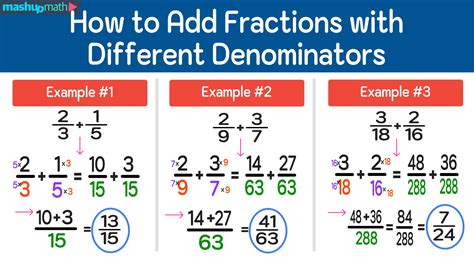
The first step in adding fractions with different denominators is to find the least common denominator (LCD). The LCD is the smallest number that both denominators can divide into without leaving a remainder. This forms the basis for transforming each fraction into an equivalent one with the same denominator. For example, if you have two fractions, 1⁄3 and 2⁄5, the LCD of 3 and 5 is 15. Transforming these fractions, you get 5⁄15 and 6⁄15 respectively, which can then be added easily.
Step-by-Step Conversion Process
The conversion process involves several straightforward steps. Begin by identifying the LCD for the fractions involved. Next, convert each fraction to an equivalent fraction with the LCD as the denominator. For example, consider the fractions 2⁄4 and 1⁄2. The LCD of 4 and 2 is 4 itself. Hence, the fraction 1⁄2 can be converted to 2⁄4 by multiplying both the numerator and the denominator by 2. Once converted, adding the two fractions becomes simple: 2⁄4 + 2⁄4 equals 4⁄4, which simplifies to 1. This process ensures that all fractions are on an equal footing before addition.
What if the denominators are large numbers?
For larger denominators, prime factorization can assist in determining the LCD. Break down each denominator into its prime factors, then multiply the highest powers of these factors to find the LCD.
Can fractions with different denominators be added without converting them first?
No, to add fractions effectively, they must first be converted to equivalent fractions with a common denominator. Without this step, the addition process remains undefined.
In conclusion, mastering the addition of fractions with different denominators relies on the identification and use of the least common denominator. By following systematic strategies and converting to equivalent fractions, the complexity of fraction addition diminishes, revealing a process that, while seemingly intricate, is straightforward with the right approach. This insight not only simplifies calculations but also lays a robust foundation for more advanced mathematical operations.